
New Balance FuelCell SC Rebel Review
 The New Balance SC Rebel is a neutral, carbon-plated road running shoe designed to provide some propulsion, making it easier to run fast with good form. For some runners, the SC Rebel will be their race-day and faster training-session shoe. For others, it will be used for steady runs, tempos and threshold workouts, with the lighter and more responsive New Balance SC Elite v6 being used on race day.
The New Balance Rebel v5 has established itself as a road running shoe that can be used for everything from easy runs to fast intervals. The SC, or Super Competition, version of the Rebel has the addition of a new, more responsive midsole foam and a carbon plate. This increases the propulsion that the Rebel offers and controls the runner’s gait more effectively. Both additions offer the runner a bit more propulsion to help them run quicker for the same level of effort.
Carbon-plated running shoes that are marketed as everyday running shoes aren’t something we are a fan of. The more work that the shoe does for the runner, the less the body is stimulated and therefore the less effective the training session is at stimulating the muscles. The rocker, or curved shape of the midsole, keeps the foot moving when it touches the floor. This helps to control the gait of the runner, making it easier to maintain a high cadence and a more upright running style. The result is a more efficient running action, which makes the runner lighter on their feet.
The good part of this is that it stimulates the glutes and hamstrings to function. The bad part is that it reduces the effort required to lift the foot off the floor. We would suggest that it’s better to use a shoe like the SC Rebel more sparingly: once a week for your steady or tempo run and once a week for your faster workout. If you use a running shoe that offers less guidance and propulsion for your other runs, then the body becomes less reliant on the shoes. You learn the posture and cadence but also develop strong muscles.
The rocker in the SC Rebel is designed to help earlier in the gait cycle. This makes it more effective at slower paces, which makes the SC Elite a better choice of carbon-plated race-day shoe for non-elite runners who tend to land closer to the heel.
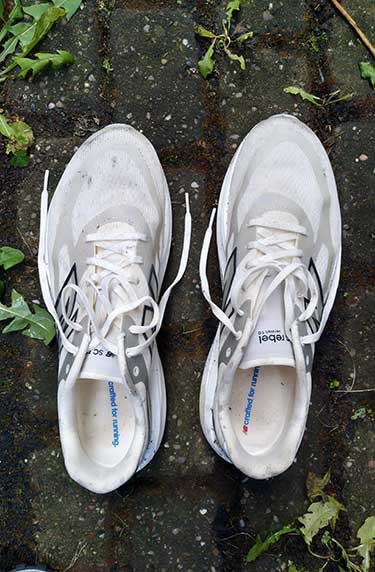
 As the SC Rebel isn’t designed as a stripped-back race-day shoe, it still has elements of comfort in the upper. The heel cup and cuff are nicely padded. The tongue is lightly padded but lovely and soft, easily moulding to the shape of the foot. The tongue is attached to the base of the shoe with two mesh strips of material. This, together with the tab on the outside of the tongue, helps to hold the tongue in place and stop it from slipping to one side when running.
This construction also helps to give the SC Rebel a snugger fit around the midfoot. When the laces are pulled in, it gives the SC Rebel a fitted, race-day feel. The mesh upper is light and, although it is see-through enough to see your socks through the upper, the mesh isn’t open enough to allow a completely free flow of air. This is a good thing if you often train on chilly mornings in the UK. The inside of the upper is soft and seamless, adding to the comfort.
There is an additional lace hole at the top of the laces which can be used to make the heel fit snugger or to butterfly lace the shoes. The fit is snug, more like a race-day shoe than an everyday trainer. The big toe line is straight to allow for a positive push-off.
New Balance running shoes are similar in length to Hoka, Karhu, Inov-8 and La Sportiva. If you use Brooks, Saucony, Topo, 361 or Altra, then we would suggest trying half a UK size larger in order to get a similar length. The New Balance SC Rebel is available in a D width (normal) and a 2E width (wide).
The midsole foam is New Balance’s newly developed Infinion. This is a blended foam that is light and responsive, offering the stability of supercritical EVA with the cushioning and rebound qualities of TPEE. The result is a light and responsive ride. There isn’t a lot of compression on impact, which helps to make the SC Rebel feel smoother, especially when running quickly. Infinion is also lighter, helping to take the SC Rebel down to 218 grams for a men’s UK 8.
Sandwiched between the upper and the midsole is an Energy Arc carbon plate. This helps to maintain the stiffness in the midsole even when you have been running for a few hours. This maintains the rocker shape, making it easier for the runner to maintain good posture and a high cadence. It also adds a bit of spring, which means that the runner travels further through the air with each stride.
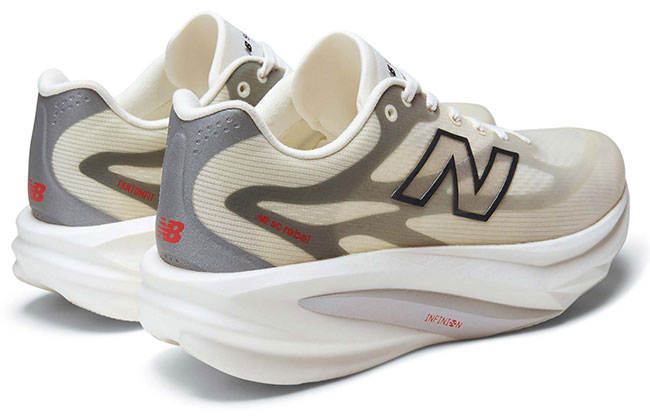 The stack height is 40mm in the heel and 36mm in the forefoot. When the shoes are on your feet, they don’t feel as high as the stack height would suggest and the SC Rebel feels very stable. This is partly due to the lower amount of compression in the Infinion foam, partly the 4mm heel-to-forefoot drop and partly because the foot sits inside the midsole.
The 4mm drop promotes a more midfoot landing, which reduces braking when the foot touches the floor and helps to reduce overstriding, making it easier to maintain good posture and a higher cadence.
I found the SC Rebel was a nice shoe to run in at quicker paces. Steady runs and tempo runs were smooth. The problem with long runs was that the shoes carried me along at a quicker pace than I wanted to run, making it harder to recover from the long run. The same was true for easy recovery runs.
The SC Rebel feels a bit stiff and awkward at slower paces and, when you relax and let the shoes carry you up to quicker paces, it’s harder to recover in time for your next quicker session. This is often the problem with running shoes designed to be used for all of your running: they make your easy runs quicker. Although the shoes are doing some of the work for the muscles, you are still breathing harder than you would be if you were running easy in a running shoe with no propulsion, and your heart rate is often higher.
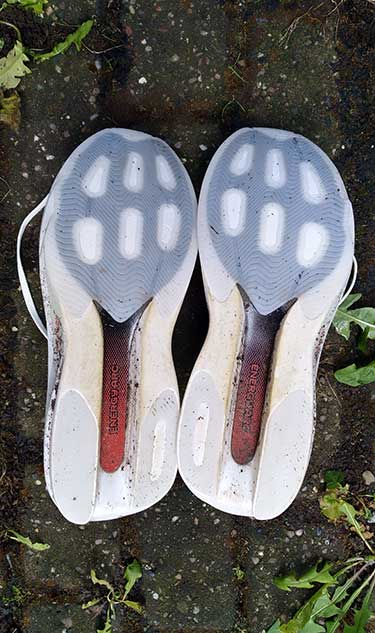
In running shoes that have a high stack height and very little feel for the floor, it is essential to have an outsole that grips well in a variety of conditions. I have found the traction on the SC Rebel to be very secure. My first run in the shoes was a steady run in the pouring rain after a spell of very dry weather. This usually makes tarmac roads slippery, but I had no traction issues in the SC Rebel.
I would suggest that the New Balance SC Rebel is best partnered with an everyday training shoe like the New Balance 880v15, which would allow the runner to run easy on recovery days (https://www.northernrunner.com/blog/new-balance-fresh-foam-x-880v15-review/). The SC Rebel could then be used for faster running at steady-run pace and quicker.
In summary, the New Balance SC Rebel is a carbon-plated road running shoe that is suitable for more than just race day. A less aggressive rocker and more stable platform make it an ideal fast-running shoe for non-elite runners.
Alternatives to FuelCell SC Rebel
Hoka Mach X 3: I found that I was less aware of the rocker and carbon plate in the Mach X 3 than in the SC Rebel. This made it easier to run at slower paces without the shoes pushing up the pace. https://www.northernrunner.com/blog/hoka-mach-x-3-review/
Brooks Hyperion Max: These feel a much larger shoe. Not as good at really quick paces like Intervals but, lovely and smooth on tempo or steady runs. https://www.northernrunner.com/blog/brooks-hyperion-max-4/
Mount to Coast R1: These are designed as an Ultra road racing shoe but, as I use them more I am finding that they are very versatile. There is no plate so they don’t carry you a long quite the same but, the unique anti sag in the cushioning does make you feel like you want to keep going. Not a super fast shoe so perhaps not great for short intervals but, great at everything else. https://www.northernrunner.com/blog/mount-to-coast-r1-review/
Comments are closed here.