
Mount to Coast R1 Review
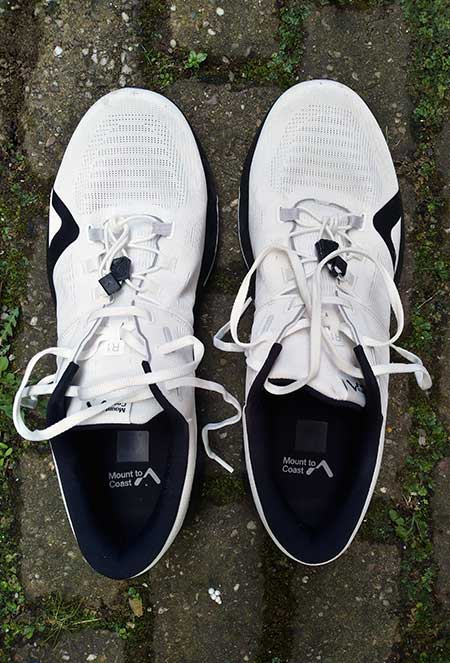 The Mount to Coast R1 is a neutral road running shoe designed for ultra-distance road racing or training. That said, you don’t need to be heading out beyond the marathon distance to use them. Many of the R1’s attributes simply make it a very good all-round road running shoe. It is light, stable, and features a durable, resilient midsole that doesn’t lose its rebound over long periods on your feet or after high mileage. I haven’t had my pair long enough to fully test this, but there are reports of runners getting over 800 miles out of the R1 before noticing any softening in the midsole.
When I think of running shoes designed for ultra distances, I picture oversized midsoles made from very soft foam, often paired with a pronounced rocker. Essentially, they are shoes that do a lot of the work for you. They feel good at ultra pace, but when you try to run quicker, the midsole can feel too soft and the shoe can feel bulky. The Mount to Coast R1 is the complete opposite. It feels more like an old-fashioned road racing shoe. A men’s UK 8 weighs 240 grams and feels even lighter on foot. The midsole has very little compression and feels responsive, allowing you to run quickly, while still offering enough cushioning that even after a two-and-a-half-hour run, my legs felt relatively fresh.
The R1 could be a true do-it-all road shoe for neutral runners. I’ve used them for track sessions on a cinder track, where they felt easy to run fast in. There is no rocker or carbon plate doing the work for you. The R1 doesn’t add propulsion; it simply feels natural and easy to run in. The midsole is firm and solid, yet not harsh on impact. The shoe provides enough stiffness to give you a stable platform to push off from, but not so much that it interferes with your natural gait. On long steady runs over an hour and a half, I felt like I could cruise comfortably. On easy runs, I could move at slower paces without the shoe feeling hard or overly firm, and without any forced propulsion encouraging me to speed up. So far, they’ve been comfortable across all paces and distances I’ve tested. After just over 100 miles, the midsole still feels the same as it did on the first run. There has been no noticeable softening, which is often something I experience at this point with other road shoes.
Despite the low weight, Mount to Coast haven’t cut corners with the upper. The heel cup features a firm thermoplastic counter, with a good level of padding inside that extends around the collar. The tongue is soft and lightly padded, particularly at the top where the lace knot sits, with less padding towards the forefoot to improve breathability. It is gusseted through the centre to help keep it in place, and includes a lace tab to prevent it from slipping to one side while running.
The lacing system is split into two sections. The upper uses a conventional lace with an additional eyelet for a more secure heel lock or runner’s loop. The lower section uses a separate pull-toggle system. This allows you to secure the heel and midfoot while leaving the forefoot slightly looser, which is particularly useful if your feet swell during longer runs or races.
The upper is made from a lightweight, breathable mesh. The toe box is fairly roomy. It’s not as wide as Altra or Topo, but it offers more space than Brooks, New Balance, Hoka, or Saucony. The toe box shape allows the big toe to sit relatively straight, giving a more natural and effective toe-off without pushing the toe inwards.The midsole consists of two components. Mount to Coast partnered with BASF to develop a midsole insert called ZeroSag. This insert helps prevent the foam from losing energy return, sagging, or softening during long runs. As a result, the ride feels just as smooth and responsive at the end of a long run as it does at the start.
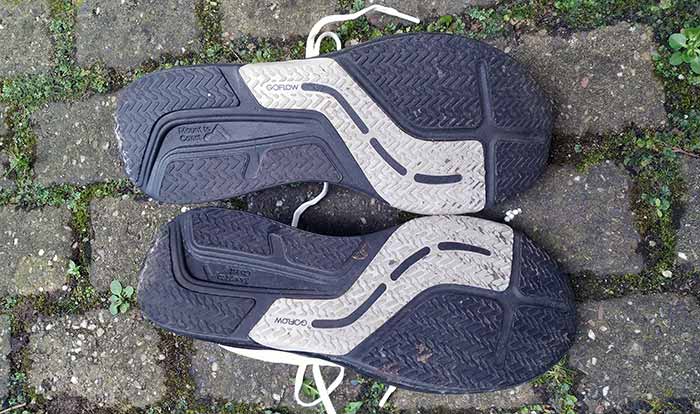 The main foam is Lightcell, a nitrogen-infused material that is around 50% lighter than EVA and offers approximately 45% more energy return. Because the foam is nitrogen-infused, it is sealed, helping to retain its bounce over time. It also doesn’t absorb water or allow grit to enter, which helps improve long-term durability. The outsole uses a durable rubber compound that provides reliable traction. Even on wet tarmac, which can often be slippery, I found the grip to be good. Because the midsole is firm rather than overly soft, you maintain a good sense of ground contact and foot placement, which helps promote a smoother and more natural stride. It doesn’t feel like you are being tipped forward by a rocker or bounced along by an overly soft midsole.
The stack height is 35mm in the heel and 27mm in the forefoot. The drop feels slightly lower than the stated 8mm, and I found it easy to land naturally on my midfoot. The R1 doesn’t attempt to control your gait, which contributes to its natural feel. In terms of sizing, Mount to Coast can vary slightly. The R1 is similar in length to Brooks, Saucony, 361, Altra, and Topo. If you usually wear Hoka, New Balance, Inov-8, Karhu, or La Sportiva, I would suggest trying half a UK size smaller. For example, a UK 11 in the R1 is roughly equivalent in length to a UK 11.5 in Hoka.
In summary, the Mount to Coast R1 is a lightweight, responsive, and well-cushioned neutral road running shoe. Although it has been designed with ultra running in mind, it is far more versatile than that and performs well across a wide range of paces and distances.
There aren’t many road shoes that combine this level of cushioning with such a responsive, natural feel. For many runners, the R1 could be an excellent marathon racing option, particularly if you don’t benefit from, or can’t fully utilise, a carbon-plated shoe. In those cases, you may find you can run just as fast, if not faster, in the R1.
Comments are closed here.