
Brooks Hyperion Max 4
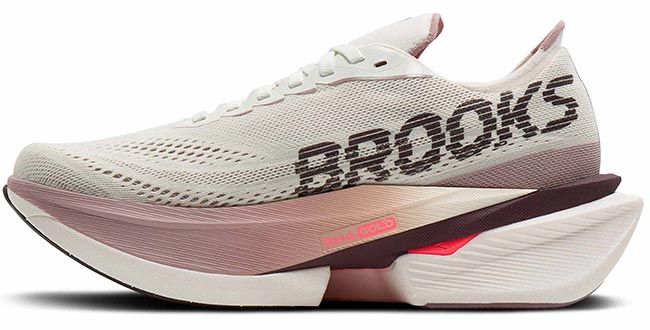 The Brooks Hyperion Max 4 is designed for fast training runs. It has a high level of cushioning and propulsion. The Hyperion Max 4 is best used for steady runs or tempo runs. The high stack height provides a cushioned but responsive feel to the ride, with plenty of protection, making it easier to recover from long tempos while marathon training. They are perfectly fine for intervals of longer than three minutes. When you are running shorter, faster repetitions, they feel a little bulky and not quite reactive enough. The Hyperion Max 4 feels much better when cruising along fast.
On first look, it would appear that the Brooks Hyperion Max 4 is just the same as the Hyperion Max 3, with a few cosmetic changes to the upper. This is not my experience. The previous version didn’t agree with me. I found them bulky and overly soft. This wasn’t helped by the fit of the upper, which didn’t hold my foot onto the midsole well. Other members of the Northern Runner team loved the Hyperion Max 3, so I was in the minority, but my experience of the previous version didn’t leave me excited about trying the new one.
The first impression when placing my feet into the Hyperion Max 4 was that they felt incredibly comfortable. Brooks works hard at getting the step-in feel of its shoes right and, in this case, it has worked. The heel cup is firm and stiff. Inside the cup is a nice level of thick padding that moulds nicely to your foot. The padding continues around the cuff of the shoe, giving the Brooks Hyperion Max 4 a lovely snug fit at the heel. The upper is made from a soft engineered mesh that has less volume than the previous model and hugs my foot much better. The fit has the comfort of an everyday training shoe but the snugness of a racing shoe.
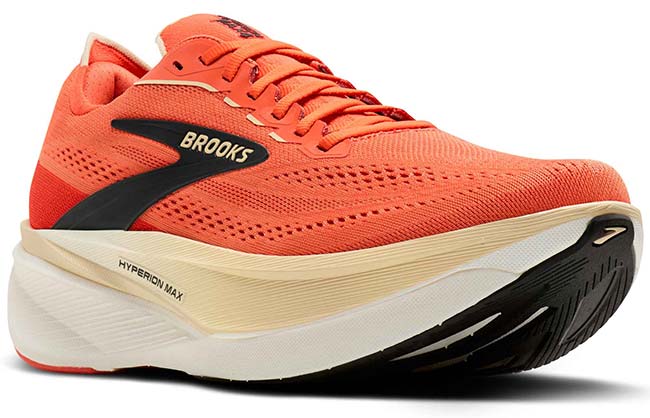
The tongue is thin, but with a firm piece of padding over the centre, which is enough to protect your feet from the laces. The tongue attaches to the base of the shoe and is slightly elastic, which helps create some of the snug feel to the fit. When laced up, the upper pulls in nicely around the foot. There is an extra lace hole at the top of the laces, so you can make the heel fit snugger or butterfly lace the shoes. The big toe line is straight, which allows for a positive push-off. The curved, rocker-shaped midsole guides the foot through to toe-off, adding propulsion by improving the running gait and helping to maintain a quick cadence.
The midsole and outsole have the same construction as the previous version: 45mm of stack height in the heel and 39mm in the forefoot. The 6mm heel-to-forefoot drop promotes more of a midfoot landing and helps reduce the braking effect of heel striking. The top layer of foam is Brooks’ softest and most responsive foam, DNA Gold. Below this is a nylon propulsion plate, which sits on top of a layer of DNA Flash v2 foam. The base foam is firmer and, together with the plate, helps to give the Hyperion Max 4 a stable ride.
The midsole is curved so that the foot is kept moving the moment it touches the floor. This helps to get the foot from landing to toe-off quickly, maintaining a quick cadence and upright posture, making the runner lighter on their feet and ultimately quicker. When your foot touches the floor, there is some compression but not a lot, and the rebound of the midsole gives the feeling of bounce. The rocker isn’t too aggressive, so you don’t feel like the shoes are in control. At toe-off, the feeling underfoot is firm and positive, and when running on flat roads, it is easy to just cruise along quickly. On up-hills, the firm forefoot helps you skip up the hills. On downhills, you are just cruising, unless the hill is very steep, in which case, as with all high-stack shoes, they don’t ride as well.
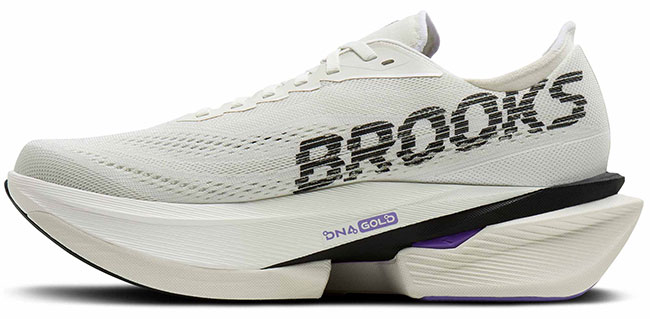 Brooks running shoes are similar in length to Saucony, Topo, Altra and 361. If you use Karhu, Hoka, New Balance, Inov-8 or La Sportiva, then we would suggest trying half a UK size smaller. For example, a UK 11 in Brooks is a similar length to a UK 11.5 in Hoka. A men’s UK 8 weighs 286 grams, which is light for such a well-cushioned shoe with a stable, durable feel to the ride.
I have mainly used the Brooks Hyperion Max 4 for long runs with pickups in and longer threshold intervals. The greatest advantage that they have is that my legs didn’t feel as beaten up from impact as they usually do. So, running the next day, I was less stiff. My muscles still felt a bit tired and worked, but I was able to move freely and get into my running more easily, as everything was less stiff. On the long runs with pickups, I found that the Hyperion Max 4 feels better when you are running quickly, so this led to the gap between the pickups being a bit quicker than normal, as it felt easier to keep cruising along. It is noticeably more difficult to run slowly in the Hyperion Max 4.
The difference in the ride and comfort of the Hyperion Max 4 compared to the previous version is quite marked. With a snugger upper and a slightly firmer feel to the midsole, it is a shoe I have enjoyed running in, compared to the previous version, which felt bulky and a bit too soft. The other members of the Northern Runner team who enjoyed the Hyperion Max 3 equally enjoy the Hyperion Max 4.
In summary, the Brooks Hyperion Max 4 is a neutral road running shoe designed for training fast. It is ideally suited to longer tempo or steady runs, but equally nice for longer intervals or threshold running. The new upper provides a snugger, more racing-style fit with a bit of extra padding for comfort. The ride is a touch firmer and more responsive.
Alternatives to Brooks Hyperion Max 4
Mount to Coast R1: The R1 is designed for quick running over distance but has a very different design. There is no rocker to propel you a long and although the R1 is well cushioned there is more feel for the ground and the shoe is more flexible so your feet function more in the shoes. The feeling of running in this type of running shoe is very different. Rather than riding the shoe as it carriers you through the gait cycle you have to work each stride utilising the spring from your feet. You don’t run as fast but, it could be argued that you get more of a workout. https://www.northernrunner.com/blog/mount-to-coast-r1-review/
VJ Tempo: A rounded toe box allows more foot function and a firm midsole lets the feet know you have touched the floor. These might be a bit firm for a lot of runners looking to do long runs or long distance tempo’s. They are designed as a road to trail shoe, so they do have a bit of traction which is good for mixed runs. For thresholds and speed work these feel nimble and responsive. https://www.northernrunner.com/blog/vj-fzn-tempo-review/
Saucony Azura: A similar stack eight but a firmer midsole with no plate. The Azura isn’t quite as plush and smooth in my experience but, does feel quicker on shorter intervals. https://www.northernrunner.com/blog/saucony-endorphin-azura-review/
Hoka Mach X 3: Better at the shorter distances. Not quite as plush or protective on the long runs and doesn’t have the same plush cruising feel that the Hyperion Max 4 has. https://www.northernrunner.com/blog/hoka-mach-x-3-review/
New Balance Rebel v5: A lot softer ride with a more noticeable rocker. Doesn’t carry you a long quite as much so not really a long distance cruiser but, nimble enough for short hills and short intervals despite the soft ride and high stack height. https://www.northernrunner.com/blog/new-balance-fuelcell-rebel-v5-review/
Topo Specter 2: A broad rounded toe box gives the feet the room to spread and function in the shoes. The midsole is very bouncy. There is no plate. The Specter 2 doesn’t have the cruising feel of the Hyperion Max 4 but does have a fast bouncy feel with a very noticeable rocker to give a good level of propulsion. https://www.northernrunner.com/blog/topo-athletic-specter-2-review/
Comments are closed here.