
Brooks Hyperion Elite 6 Review
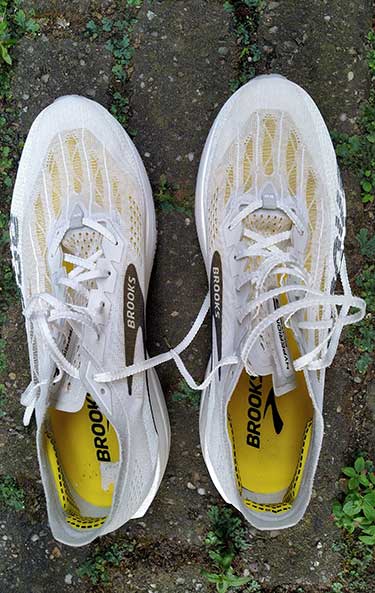 The Brooks Hyperion Elite 6 is a neutral, carbon-plated road racing shoe. It is designed to give the runner a bit of extra propulsion on race day and help them maintain a fast pace for longer. Hyperion is the name of Brooks’ range of running shoes designed to help the runner go faster. On the road running side, this now consists of the Hyperion Max 4, which is a neutral road running shoe designed to be used for tempo runs, steady runs and threshold sessions and the Hyperion Elite 6, which is the carbon-plated road racing shoe suitable for distances up to the marathon.
The Brooks Hyperion 3 has been redesigned and is now the Brooks Ghost Amp, changing from a fast shoe you can train in to a training shoe you can run fast in. The Brooks Hyperion Elite 6 is very different to the previous version. The shape is very similar to that of most other Brooks shoes, but the similarities end there. The Hyperion Elite 6 has been completely redesigned.
The upper uses a similarly aerated mesh, but it is much softer to the touch. The heel cup is firm, but the rest of the upper is more pliable and pulls in around the foot when the laces are tightened. There are a few strategically placed pieces of padding in the heel. These have silicone grippers on the outside to give the heel a firm, snug fit. This is noticeably snugger than the previous version. Your foot sits inside the midsole of the shoe, which gives an element of stability and helps the shoe guide the foot through the gait cycle. The tongue has a very thin piece of material down the centre to protect the top of your foot from the laces. There is no tongue stay. Instead, the tongue is stitched to the medial side of the shoe to prevent it from moving while running.
BROWSE BROOKS HYPERION ELITE 6
The laces are ribbed, as they were on the previous version. This helps prevent them from coming untied. It also helps you get a snug fit, as when the laces are pulled through the lace holes, the ridges hold them in place so they don’t slip back through. This can mean that you pull your laces a little too tight, but with practice it means you can get a nice, snug racing fit. There is an additional lace hole at the top. This can be used to make the heel fit snugger or to butterfly-lace the shoes. As with the previous version, the insole is lightly glued onto the midsole. This is to keep it in place when cornering at speed. However, if you need to take it out to replace it with an orthotic or another insole of your choice, it can easily be removed. The midsole foam is DNA Gold, but it is slightly firmer than the DNA Gold used in the midsole of the Hyperion Elite 5 and has a high level of noticeable rebound. When running in the Hyperion Elite 6, this makes the midsole feel bouncier, more stable and more substantial underfoot.
This is much more like the ride of other Brooks running shoes and is more likely to appeal to runners who are already happily running in Brooks shoes. The midsole is soft and bouncy, which gives it a slightly unstable feel when you are walking in the shoes, but it is much more stable than a lot of other carbon-plated road racing shoes on the market. The foam also seemed to maintain its integrity better than the foam in other, softer super shoes. After an hour and a half of steady running, the Hyperion Elite 6 felt just the same as it did when I started the run. I find that a lot of softer-foamed shoes feel like they bottom out after this length of time, changing the feel of the ride.
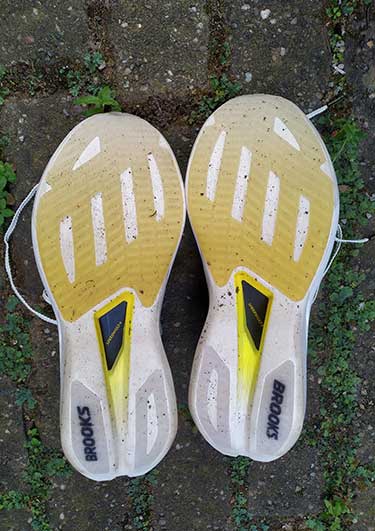 The SpeedVault+ plate has been redesigned and now has a more aggressive curve. I found that this promoted a more upright running posture and a slightly quicker cadence. Importantly, the shoes help the runner maintain good posture so that they can continue running with a quick cadence and a more upright position. This makes the runner lighter on their feet, allowing them to travel further through the air with each stride. The carbon plate stiffens the shoe, and the soft foam takes away some of the feel for the ground, which makes it difficult to run down steep descents in this type of shoe. They are best used on flat routes where you can get up to speed and then concentrate on maintaining it without having to negotiate too many hills, twists or turns. That said, the only stretch of flattish road I have near me that can be used for thresholds or intervals has a broken tarmac pavement with a noticeable camber. I find that I am constantly jumping on and off the pavement to avoid traffic and low-hanging trees. The Brooks Hyperion Elite 6 is fine for this. There is still enough feel to negotiate paving slabs and similar obstacles. Other softer or less stable super shoes don’t have the same sure-footedness.
The stack height is the same as the previous version: 40mm in the heel, which is the maximum height allowed for racing, and 33mm in the forefoot. The 7mm difference between the height of the heel and the forefoot helps Brooks increase the amount of propulsion. The rocker is very noticeable when standing in the shoes. When you start to run, you naturally move quicker than you otherwise would, as the shoe carries the foot through the gait cycle. On long threshold sessions or long steady runs, I found the cushioning to be effective. The following day, my legs didn’t feel as battered, and at the end of the session I felt that I could have completed another few efforts or continued running at the same pace.
Having enjoyed running in the Hyperion Elite 6 on the road, I decided to use them for a treadmill threshold session. The treadmill I have doesn’t have a motor. You have to pull the belt along yourself. This helps you run with good posture, reduces over striding and works the hamstrings and glutes. I usually use quite minimal running shoes, such as the Topo Cyclone 3 or the Altra Escalante 4.
The first thing I noticed was that I felt much closer to the ceiling because I was more upright, and I felt much lighter on my feet. I could feel the muscles in my lower back working, and it seemed easier to move my legs faster, or run with a faster cadence. Threshold pace was quicker and easier to maintain. Even warming up and cooling down were quicker. I didn’t have the same feeling that my glutes and hamstrings had worked hard. Instead, my lower back muscles felt like they had been worked. On the following morning’s run, my legs had no stiffness. The muscles felt like they had been worked, but I didn’t have the same feeling of stiff, beaten-up legs. The Hyperion Elite 6 improves my running economy when I am running in them, but it also does some of the work that my body should be doing, particularly my feet and lower legs.
So that my feet and lower legs don’t get weaker, I have been using the Hyperion Elite 6 sparingly: once a week for one of my quicker runs. Some of the other runs in my weekly schedule are done in more minimal running shoes and on trails, so my feet, ankles and lower legs have to do a bit more work, which keeps them strong. This rotation works well for me, as my body can learn the improved posture that I get from running in the Hyperion Elite 6 while maintaining the spring from my feet. The Hyperion Elite 6 is very light. A women’s UK 5 weighs 172 grams, and a men’s UK 8 weighs 198 grams.
The sizing is in line with other Brooks shoes, which are a similar length to shoes from Altra, Topo, Saucony and 361°. If you use New Balance, Hoka, Inov-8, Karhu or La Sportiva, then we would suggest trying half a UK size larger to get a similar length. For example, a UK 11 in Brooks is a similar length to a UK 11.5 in Hoka.
In summary, the Brooks Hyperion Elite 6 gives the runner a more aggressive level of propulsion with a slightly firmer, bouncier feel to the ride. Although they are designed for out-and-out racing, they can also be used for a weekly fast session or run to get used to the shoes and help improve posture.
Alternatives to Brooks Hyperion Elite 6
Saucony Endorphin Pro 5: A firmer ride with less bounce. This does make them easier to get used to and easier to get a rhythm going.
https://www.northernrunner.com/blog/saucony-endorphin-pro-5-review/
Hoka Cielo x 1 3.0: A similar feel to the foam, just a touch softer. A bit more unstable and doesn’t have quite the same positive feel at push off.
https://www.northernrunner.com/blog/hoka-cielo-x1-3-0-review/
New Balance Supercomp Elite v5: A much softer feel to the foam with a nice bounce. The softness gives Supercomp Elite v5 less feel for the ground.
https://www.northernrunner.com/blog/new-balance-fuelcell-supercomp-elite-v5-review/
Hoka Rocket X 3: A similar ride to the Saucony Endorphin Pro 5 which is firmer with less bounce than the Hyperion Elite 6 but, easier to get used to and run in.
https://www.northernrunner.com/blog/hoka-rocket-x-3-review/
Comments are closed here.