
Hoka Cielo X1 3.0 Review
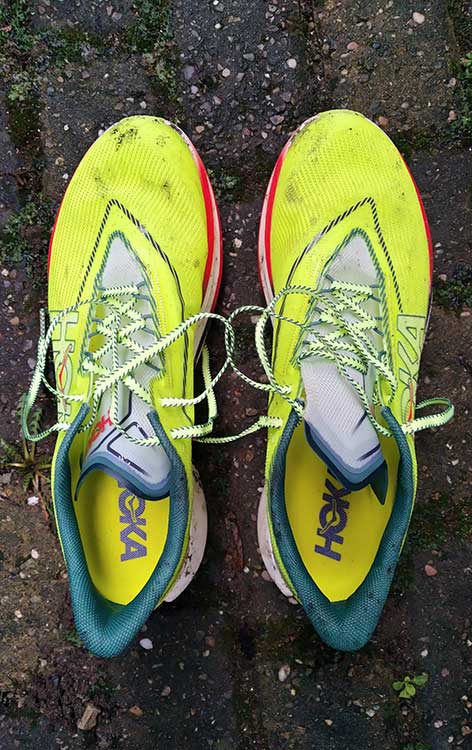 The Hoka Cielo X1 3.0 is a carbon-plated road racing shoe designed to add a level of propulsion when running on flat, hard surfaces such as roads. How much “free speed” you get from the shoe depends on how effectively your running gait loads the carbon plate, which, together with the high-rebound foam, pushes you further forward with each stride.
The Cielo X1 3.0 has been designed for quicker runners who tend to land on their midfoot when running at pace. The foam at the heel is very soft and, although the Cielo X1 3.0 is much more stable than the previous version, it is still not stable enough for a heavy heel striker. If you are a heavy heel striker and are looking for a road running shoe to help you run faster, we would suggest considering the Hoka Rocket X 3 or the Hoka Skyward X. Both of these carbon-plated road running shoes use a stiff carbon plate to carry the runner’s foot through the gait cycle.
The Hoka Cielo X1 3.0 works slightly differently. It relies on loading the plate and compressing the foam to generate rebound. The harder you push, the more rebound you get. If you land on your midfoot with your foot under your centre of gravity, you will naturally load the plate. If your foot touches the floor too far in front of your centre of gravity, there will be a heavy braking force, and the shoe will feel unstable and less effective. I wasn’t fast enough for the previous version of the Cielo. I found it helped at mile pace, but if I slowed slightly it didn’t make me much quicker. On longer efforts, my knees ached due to the very soft midsole, which made the shoe feel unstable at slower speeds. Because of this, I wasn’t particularly looking forward to running in the Hoka Cielo X1 3.0.
When I first put the shoes on, they felt very soft. Not as soft as the previous version, but still extremely cushioned. The stack height is 38mm in the heel and 31mm in the forefoot, and there is no real feel for the ground at all. Jogging down the street, they felt soft and slightly unstable. Of course, they aren’t made for jogging. During strides, the Cielo X1 3.0 went from feeling unstable and uncomfortable in the warm-up to feeling like rocket launchers. The rocker-shaped midsole, combined with the 7mm heel-to-forefoot drop, puts you onto your forefoot and helps you load the carbon plate and compress the foam. The rocker helps keep cadence quick, and the shoe feels very fast.
During the main part of the session, which was mile repetitions at just under threshold pace (fast, but not all-out), I found that my legs felt less tired during recovery and at the end of the session. For the same heart rates and perceived effort, my times were slightly quicker. By the warm-down, I had decided that the Hoka Cielo X1 3.0 wasn’t too bad a shoe for me after all.
A few days later, I took the Cielo out again. A three-mile threshold run was 50 seconds faster at the same heart rates compared to the previous week. I then did four roughly one-minute hill reps. Previously, carbon-plated road racing shoes with a high stack height and very soft foam have been terrible on hills. I often felt like I was sinking, with my hamstrings and glutes working extremely hard to get me up the hill, usually in a slower time than in normal training shoes. The Cielo X1 3.0 does feel soft, but you can feel the foam springing you up the hill. The curved shape of the shoe puts you in a good posture, and my times for each repetition were around two seconds faster than the previous week. I finished the session with another mile at threshold pace, which felt great and was again faster than before. After the session, the muscles in my legs felt worked, but my joints felt less stiff. The following day, I felt no stiffness at all. Normally, after a long or hard session, my legs feel tired and stiff initially. It’s fair to conclude that the Hoka Cielo X1 3.0 helped me run faster while also reducing some of the impact on my body.
At 213 grams for a UK size 8, the upper is very light and thin. The heel cup is soft and pliable but maintains its shape well. There is light padding in the heel cup and around the collar. Although the shoe feels light, it doesn’t feel like Hoka have skimped on comfort. I found the heel fit to be good. The tongue has no padding but is made from a very soft material and comes up high enough to protect the top of the foot from lace pressure. The lacing follows an asymmetrical line down the foot, following the highest part of the instep. The fit is neater, with less volume than the previous version. The laces thread through the tongue to prevent it from slipping, and there is an extra lace hole to allow for a more secure heel lock.
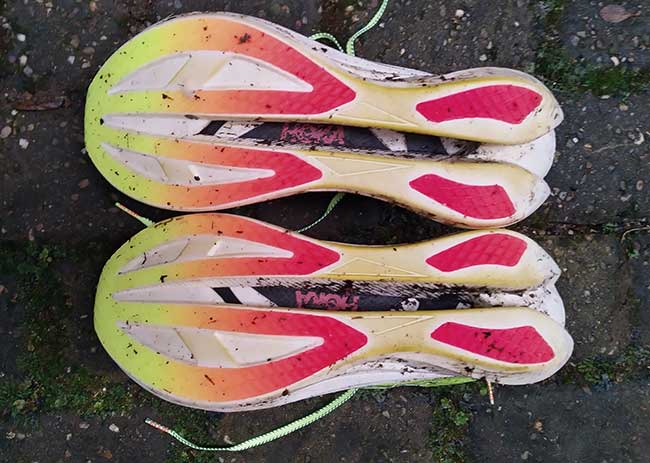 When laced up, the upper pulls in nicely around the foot. The big toe line is straight, and you can feel the shoe guiding the foot to toe-off under the big toe. The upper is designed to hold the foot securely on the midsole, which it does effectively. On cambered footpaths, you do feel some movement inside the shoe. The carbon plate is very stiff and doesn’t flex much, so the upper has to work hard to keep the foot in place. The redesigned carbon plate is thinner through the midfoot and more flexible than the previous version, which helps it cope better with uneven roads. The very soft midsole also flexes to the shape of the ground, so while the movement is noticeable, it doesn’t cause any issues or hinder forward progress.
The midsole construction is similar to the previous version, with a slightly firmer foam at the base and a softer foam above the carbon plate. This keeps the plate away from the foot, so the shoe feels soft, bouncy, and well cushioned. You only really notice the plate when trying to bend the shoe, which you can’t. The polyurethane outsole is very grippy, which is essential given the lack of ground feel. The curved shape of the midsole encourages fast running, and once you are up to pace, the shoe feels like it wants to keep going. As with most carbon-plated shoes, the stiffness makes it harder to change direction quickly.
In terms of sizing, Hoka shoes are similar in length to New Balance, Karhu, Inov-8, and La Sportiva. If you normally run in Brooks, Saucony, 361, Topo, or Altra, we would suggest trying half a UK size larger in Hoka to achieve a similar fit. Hoka shoes are narrow fitting, and the Cielo X1 3.0 is no exception.
In summary, the Hoka Cielo X1 3.0 is a much more usable shoe than the previous version. I found it easier to run in, better fitting, and more comfortable. It helped me run faster for the same effort and reduced the stiffness and fatigue I usually associate with longer training sessions.
Alternatives to Hoka Cielo X1 3.0
Altra Vanish Carbon 2: A broader more rounded toe box allows the feet more room to spread and function in the shoes. The carbon plate is more flexible to allow for some foot function. In effect working with the feet rather than replacing them. https://www.northernrunner.com/blog/altra-vanish-carbon-2-review/
New Balance Fuelcell Super Comp Elite v5: A similar soft feel to the cushioning. These also make you faster and save your legs. Although they aren’t quite as good on the hills as the Cielo x1 3.0. https://www.northernrunner.com/blog/new-balance-fuelcell-supercomp-elite-v5-review/
Brooks Hyperion Elite 5: The Hyperion Elite 5 feels a lot lower to the floor despite the stack height being similar. They felt less different to a normal trainer and for that reason easier to run in. They also make me quicker and saved my legs but, weren’t as quick as the Cielo x1 3.0 on the hills. https://www.northernrunner.com/blog/brooks-hyperion-elite-5-review/
Topo Specter 2: There is no plate of any sort in the Topo Specter 2. Topo believe in allowing the feet to function inside the shoes. The Specter 2 has a broad rounded toe box to allow this to happen. The midsole is curved/rocker shaped and does make you go faster than you would run in a training shoe. The Peba foam is very bouncy and soft and they feel less different than the Hoka Cielo X1 3.0. The broad rounded fit also suites runners who have a higher volume or wider foot where as most of the other go faster running shoes on the market are very narrow fitting. https://www.northernrunner.com/blog/topo-athletic-specter-2-review/
New Balance Super Comp Pacer v2: These feel like a low to ground racing shoe of old. They did make me run quicker for the same effort and felt much nimbler and faster than the higher stack height carbon racing shoes. What they lack is the high level of cushioning so they don’t save the legs as much which is why they will be a 5km/10km shoe for most runners. https://www.northernrunner.com/blog/new-balance-fuelcell-supercomp-pacer-v2-review/
Comments are closed here.