
Hoka Rocket X 3 Review
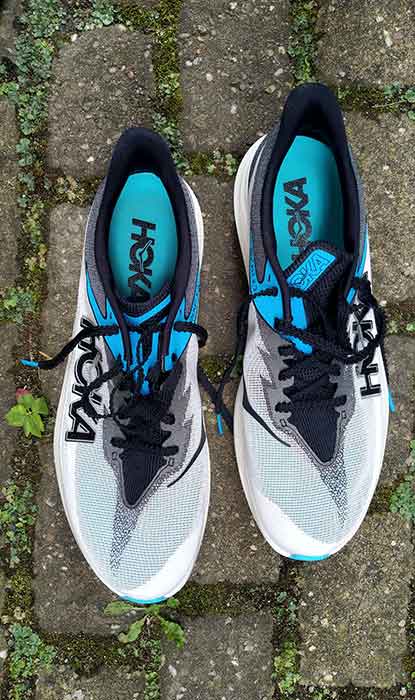 The Hoka Rocket X 3 is the most stable carbon-plated road racing shoe in Hoka’s lineup. That makes it the best race day option for most runners looking for a shoe that adds propulsion on the roads without feeling unstable. How much of an advantage you gain depends on how fast you’re running and how well you can maintain good posture—specifically landing on your midfoot with your foot under your centre of gravity to properly load the carbon plate and get that spring-loaded stride.
Unlike the Hoka Cielo X1 2.0, which demands perfect form to feel effective, the Rocket X 3 is more forgiving. The slightly firmer PEBA foam under the plate, the winged carbon plate design, and the 7mm drop all combine to keep you moving forward even if your form isn’t flawless. If you’re not chasing elite paces or are targeting a four-hour marathon, something like the Hoka Skyward X offers more support for longer efforts (full review).
The Rocket X 2 was already a popular racing shoe, mainly because it felt more “normal” underfoot than some of the more extreme carbon models—making it versatile enough for interval and tempo sessions as well. Hoka has preserved that feel in the Rocket X 3, but increased the stack height to 42mm in the heel and 35mm in the forefoot. The midsole uses two densities of PEBA foam: a firmer layer under the carbon plate and a softer one above it. This adds stability without compromising bounce. The plate itself is winged—extending across the width of the forefoot to deliver a more stable toe-off. You don’t feel the plate directly underfoot because of the soft top layer, but the rebound is definitely there.
As with most Hoka shoes, the Rocket X 3 uses a rocker midsole, which helps reduce braking forces and encourages an upright posture and fast cadence. The 7mm drop allows for a more pronounced curve, making it easier to roll through your stride and load the plate—even if you land slightly behind your midfoot. Compared to the Cielo X1 2.0, I found the Rocket X 3 offered more support and was easier to run in at lower speeds. During warmups, I could feel it helping me run quicker with no extra effort. The Cielo X1 2.0, by contrast, only started working for me when I was going all-out and properly loading the plate.
At 226g in a men’s UK 8, the Rocket X 3 is impressively light for such a cushioned shoe. The upper is a super minimal, single-layer warp knit mesh—so thin you can see your socks through it. Despite the lightweight build, there’s still a bit of padding around the heel and collar. The heel tab slopes away from the Achilles to reduce rubbing. The tongue has a slim padded strip down the middle to protect the top of your foot from the laces. It’s not gusseted, but it’s held in place by a central tab that the laces thread through. The crimped laces are excellent for lockdown and don’t come undone easily.
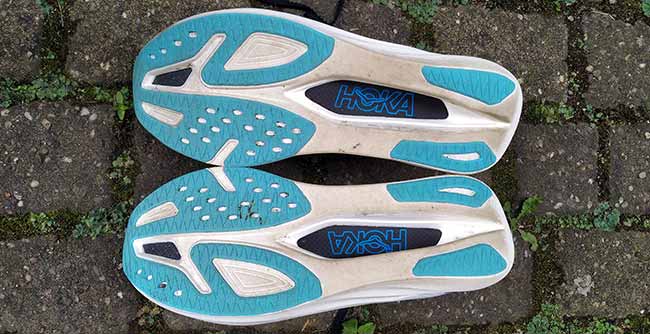 Fit-wise, it’s snug in the heel and midfoot—similar to the Rocket X 2. Hoka shoes are generally narrow-fitting, and that’s the case here. There’s an extra lace hole for heel lock or butterfly lacing if needed. In high-stack carbon shoes, ground feel is minimal—so outsole traction becomes crucial. The Rocket X 3 uses a sticky rubber compound that grips well in both wet and dry conditions, which helps you focus on running fast with confidence.
The toe-off feels strong, thanks to the straight big toe line. On hills, where some soft shoes can feel like they’re collapsing under you, the Rocket X 3 kept me forward on my forefoot and helped me push uphill. Like most carbon-plated shoes, they aren’t great for tight corners or downhills—the plate makes them feel stiff—but on fast, straight roads, they shine.
Fit guidance: Hoka shoes are similar in length to New Balance, Karhu, Inov-8, and La Sportiva. If you usually wear Brooks, Saucony, Topo, 361, or Altra, try half a size down (e.g., Brooks UK 11 = Hoka UK 11.5 for the same length).
My main testing ground for the Rocket X 3 has been mile repeats on a footpath next to a country road, with a few detours on and off the path to dodge low branches. I found them easier to run in than the Rocket X 2, which felt a bit too soft and bouncy—almost like it was propelling me upwards, not forward. The Rocket X 3 still has that soft bounce, but it feels more directed—pushing me forward instead of up.
If you prefer a firmer feel, this shoe may still feel a bit alien at first. But it works. After the first rep, I forgot I was even wearing them and just focused on the pace. With each use, they felt more natural. The next day, I noticed significantly less stiffness and fatigue in my legs than I’d expect after a hard session in an old-school racing flat. That’s thanks to the posture support and high cushioning.
When cruising through a warm-up at 30 seconds faster per mile than normal—with no extra effort and a better posture—it’s easy to see how this type of shoe could become addictive. But don’t overuse carbon-plated shoes. If you wear them too often, your feet, calves, and knees can weaken, leading to injury. Most brands (including Hoka) offer tempo shoes with a similar geometry but no carbon plate, which help keep your feet working properly. For Hoka, the non-carbon equivalents are the Mach 6 (review) and the Mach X (review).
In Summary
The Hoka Rocket X 3 is a carbon-plated road racing shoe that delivers a more stable ride and makes the benefits of carbon more accessible to non-elite runners. If you enjoyed the Rocket X 2, this update adds a bit more cushioning and delivers a smoother, more efficient ride.
Other Considerations
Brooks Hyperion Elite 5: A similar type of carbon plated road racing shoe in that it doesn’t feel strange to run in and gives some propulsion if your running style isn’t perfect. https://www.northernrunner.com/blog/brooks-hyperion-elite-5-review/
Topo Specter 2: Like all Topo shoes the Specter 2 has a broad rounded toe box to give the feet the room to spread and function. As carbon plates discourage the feet from function Topo don’t put them in their shoes. Instead the Specter has a Peba midsole that feels responsive together with a curved midsole and is faster than you might think. If you have broad feet or want a go faster shoe that still allows foot function then the Topo Specter 2 is worth considering. https://www.northernrunner.com/blog/topo-athletic-specter-2-review/
New Balance Super Comp Pacer: These feel a bit like a track spike and could be described as the minimalists carbon plated road racing shoe. There is a lot more feel for the ground than there is in the classic ‘super shoe’. https://www.northernrunner.com/blog/new-balance-fuelcell-supercomp-pacer-v2-review/
Altra Vanish Carbon 2: Like Topo Altra makes shoes with a broad rounded toe box to allow the feet the room to function in the shoes. Although the Vanish Carbon 2 has a carbon plate in the midsole the plate is flexible and made to work with the feet rather than replace them. This gives the shoes a much more natural feel to the ride. https://www.northernrunner.com/blog/altra-vanish-carbon-2-review/
New Balance Super Comp Elite 4: A very softly cushioned carbon plated road racing shoe. Available in two width men’s and women’s. https://www.northernrunner.com/blog/new-balance-fuelcell-sc-elite-v4-review/
Comments are closed here.