
Brooks Hyperion Max 3 Review
 The Brooks Hyperion Max 3 is a highly cushioned training shoe designed to deliver both comfort and propulsion—perfect for runners prepping for race day. The cushioning feels soft on landing with a noticeable rebound, and the addition of a SpeedVault plate adds a subtle but effective push. This is a shoe best suited for tempo runs, steady long runs, and even some interval or track work. However, it’s not a natural fit for easy running—the aggressive rocker, which Brooks calls RapidRoll, constantly nudges you forward. As a result, it often feels like you’re running faster than intended. It’s not a shoe that lets you cruise slowly.
The upper features a sock-like construction with an elasticated collar for a snug fit even before you lace up. The heel is structured with a firm plastic heel cup that adds stability and helps hold the foot securely over the midsole. Padding around the heel is comfortable but not excessive, and the tongue has a central cushioned section to protect against lace pressure. The rest of the upper is thin and breathable.
As with other Brooks speed-focused shoes, the Hyperion Max 3 has a straight big toe line. This allows for a strong, direct toe-off and frees up the rest of the toes by reducing tension, making the toe box feel roomy and natural.
—-
Three-Part Midsole
- DNA Flash v2 at the base: Brooks’ nitrogen-infused foam that’s firm, stable, and responsive.
- SpeedVault plate in the middle: a plastic propulsion plate, flared at the heel for added stability.
- DNA Gold on top: a PEBA foam that’s soft and bouncy, giving the Hyperion Max 3 its plush feel.
Compared to the Hyperion Max 2, this version is noticeably softer at both landing and toe-off. You also feel the plate’s contribution more clearly, adding some propulsion without making the shoe feel overly stiff. The updated midsole stack is now 46 mm in the heel and 40 mm in the forefoot (38 mm/32 mm foam), which significantly increases underfoot cushioning. The 6mm drop is a nice middle ground, working well for both heel and midfoot strikers. There’s enough foam under the heel to smooth out landings while still letting midfoot runners benefit from a stable, rolling transition. This added cushioning brings a bit of extra weight, but the Hyperion Max 3 is still light for the amount of foam it carries—250g for a women’s UK 5 and 280g for a men’s UK 8.
With the increased stack height and soft foam, ground feel is minimal, so traction becomes more important. Brooks has used its RoadTack rubber here—a slightly sticky compound that grips well on tarmac. I felt confident rounding corners and descending hills, which is essential in a high-stack shoe where you’re less in touch with the ground. I’ve used the Hyperion Max 3 over a range of distances and found them consistently comfortable. Despite the stripped-back upper, they feel secure and integrated—similar to the Hyperion 3—with a close fit around the ankle and a soft, sock-like feel. The cushioning is luxurious, which really comes into its own during longer efforts or tempo runs. On hilly courses, they don’t feel heavy or like you’re sinking into the foam, but they do feel more relaxed than sharper, firmer shoes. That said, I’ve finished long sessions in them feeling much fresher than expected, with noticeably less muscle fatigue and stiffness.
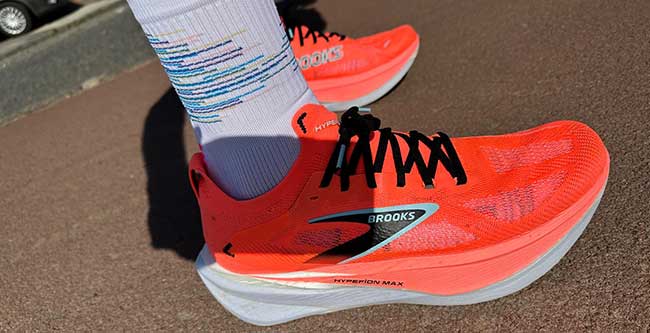 Threshold sessions were enjoyable in the Hyperion Max 3, but at faster speeds (intervals, 5K pace, etc.), I became more aware of the shoe’s bulk and softness. They’re not the snappiest at high speeds—but that’s not really what they’re for.
Each brand designs its rocker geometry slightly differently, which changes how your running muscles are loaded. So, if you’re preparing for a race in a Brooks carbon-plated shoe like the Hyperion Elite, the Hyperion Max 3 is a great training partner. It’s more durable, allows your feet to function more naturally, and helps strengthen your lower legs—making it ideal for tempo runs, long runs, and steady efforts. For shorter races (5K, 10K) or faster sessions, the Hyperion 3 pairs better with the Elite, offering a softer ride but with more agility at higher speeds.
In terms of sizing, Brooks is similar in length to Saucony, Topo, Altra, and 361. If you typically run in Hoka, New Balance, Karhu, Inov-8, or La Sportiva, try half a UK size smaller in Brooks. For example, a UK 11 in Brooks feels similar to a UK 11.5 in Hoka.
In summary: The Brooks Hyperion Max 3 is a softly cushioned training shoe with a lively ride and a touch of propulsion. It’s best for steady runs, tempo efforts, and long sessions where comfort and posture matter. While not ideal for easy jogs or high-speed intervals, it’s a highly effective tool for building toward race day in comfort.
Other Considerations
Topo Specter 2: A broad rounded toe box gives the feet more room to function inside the shoes. The Specter 2 is also likely to fit runners with broader feet too. The midsole is all PEBA but, this is firmer than the PEBA in the Hyperion Max 3 which makes it more stable and also gives a more responsive feel. You feel more like you are running in the Specter 2 but, this does take away the cruise a long feel that you get from the Hyperion Max 3. https://www.northernrunner.com/blog/topo-athletic-specter-2-review/
New Balance Supercomp Trainer v3: These have a carbon plate which does do more of the work for the feet than a plastic plate. The ride is firmer than the Brooks Hyperion Max 3 but, it has similar qualities in that you can cruise a long at a quick pace almost getting carried a long by the shoe. https://www.northernrunner.com/blog/new-balance-fuelcell-supercomp-trainer-v3-review/
Hoka Mach X 2: The Mach X 2 has a very soft feel to the cushioning. It also has a plastic plate like the Brooks Hyperion Max 3 but, you need to load the plate and then let the shoes spring you a long which is different to the Hyperion Max 3 which carries you a long more easily. https://www.northernrunner.com/blog/hoka-mach-x-2-review/
Hoka Skyward X: These have a carbon plate and a high stack height like the Brooks Hyperion Max 3. They have the cruise a long feel. The fit is narrower than the Brooks running shoe. https://www.northernrunner.com/blog/hoka-skyward-x-review/
New Balance Rebel v4: The New Balance Rebel doesn’t have a plate and relies on the rocker shape to the midsole and the rebound quality of the PEBA and fresh foam mixed midsole. As there is no plate the shoes do less of the work for your feet but, still offer a soft cushioned feel and some propulsion from the rocker. https://www.northernrunner.com/blog/new-balance-fuelcell-rebel-v4-review/
Comments are closed here.