
New Balance FuelCell Supercomp Trainer v3 Review
 The New Balance Supercomp Trainer v3 is a carbon-plated road running shoe designed for your faster training runs. The theory behind shoes of this type is that when you run in a carbon-plated racing shoe, they help you run faster by providing more spring and energy return in a lightweight package. To achieve maximum speed in this type of shoe, you need to load the carbon plate in the correct position and maintain that posture throughout the race. A training shoe like the New Balance Supercomp Trainer v3 allows you to run in the same posture but has a bit more structure, helping you maintain that form. This means you can comfortably cruise during your steady runs in these shoes, using the same posture as you would in the New Balance Fuelcell Elite v4, engaging the same muscles but with slightly less stress. The Supercomp Trainer v3 is also a more durable shoe, designed to withstand more regular use than its racing counterpart.
The New Balance Fuelcell Supercomp Trainer v3 weighs 261 grams in a Men’s UK size 8 and 210 grams in a Women’s UK size 5. While this is quite light, it’s not as light as the racing versions. The additional weight comes from the upper, which is designed for greater durability, and the midsole, composed of a 50/50 blend of Bio EVA and Fuelcell. This blend is denser and more stable than the 100% Fuelcell midsoles used in racing shoes.
Despite the pointed look of the toe box, it is quite roomy. The Supercomp Trainer v3 utilizes the same Fantom Fit as the New Balance Rebel and the Supercomp Elite v4, but the upper material is slightly thicker, making it more weather-resistant—especially beneficial now that winter is approaching. The thinner upper found in other models often allows cold air to rush in, resulting in cold toes during long winter runs. The big toe box is straight, providing a strong push-off. The padding around the heel cup is lightweight yet sufficient for comfort, allowing your heel to mold into the shoe. The tongue is gusseted, and the laces thread through a tab to reduce the chance of it moving around while running. There is an extra lace hole for a more secure fit or for butterfly lacing. The thicker upper makes the Supercomp Trainer feel snugger and more comfortable than the Rebel or Supercomp Elite, giving a more secure fit over the midsole.
BROWSE NEW BALANCE SUPERCOMP RANGE
The stack height is 40mm in the heel and 34mm in the forefoot. However, it doesn’t feel like you’re standing on a bouncy castle. Your foot sits comfortably inside the midsole, and the 50/50 blend of Bio EVA and Fuelcell provides a cushioned yet stable feel. Like all Fuelcell shoes, the Supercomp v3 features a broad base that enhances stability.
Running shoes with a high stack height and soft foam can diminish your ground feel, which can be disconcerting, especially on steep downhill sections where you can’t sense the surface beneath. In my experience, the outsole rubber used in the Supercomp v3 offers good traction, similar to what I found in the Rebel and Supercomp Elite v4. I frequently run on tarmac paths with moss, which can become slippery when wet, as do the country lanes I use for longer runs. The traction from the outsole allowed me to navigate these surfaces confidently.
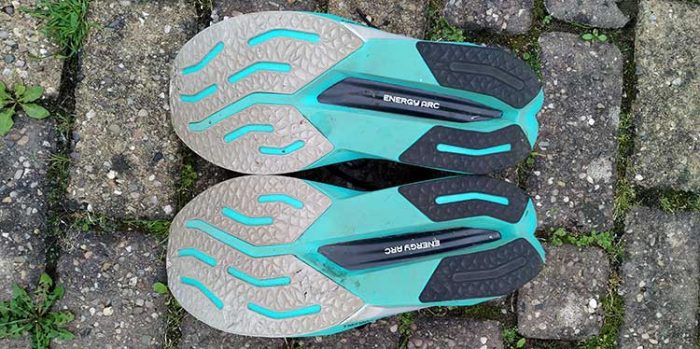 When I laced up the shoes and looked down, they appeared bulky and oversized. However, once I started running in the Supercomp v3, this perception faded. They feel light and smooth, making them great cruisers. I found I could maintain a comfortable flow at higher speeds than I typically do in my everyday training shoes. I wasn’t aware of the carbon plate until I switched from the New Balance Rebel back to the Supercomp v3, at which point I could feel that the Supercomp v3 was less flexible and provided a bit more push at toe-off.
The 6mm heel-to-forefoot drop encourages a midfoot landing, helping to load the carbon plate. This flexes and then rebounds to propel you further down the road. Additionally, the midsole is curved to form a rocker shape, which keeps your foot moving forward upon contact with the ground, helping maintain a quick cadence and reducing braking forces. The Fuelcell portion of the midsole consists of foam that rebounds quickly, further aiding your forward motion.
During interval sessions, I found that the shoes responded well to the force I applied. As a result, I completed kilometer efforts 5–6 seconds faster per kilometer than the previous week. They felt much easier, and I was ready to go again before my 60-second recovery was up. I often feel that in carbon-plated shoes, you exert less effort, allowing you to maintain the same pace or complete more intervals than in shoes that lack plating. So, it was no surprise that I felt capable of another round after my steady runs.
Shoes of this type also reduce stress on the body, so I feel less fatigued the evening after a hard session. This could be due to improved posture or the level of cushioning. It’s worth noting that you get fitter and stronger by creating damage that your body then repairs, making you stronger. Therefore, you need to stress your body and allow it to rest. Plated shoes do much of the work for your feet, so it’s wise not to use them too often, ensuring you still stimulate foot function and encourage your feet and lower legs to grow stronger, pushing you forward.
In addition to the recovery benefits from fast training shoes like the New Balance Supercomp Trainer v3, you also learn to run with better posture. It’s always beneficial to incorporate exercises that stimulate your glutes and hamstrings, as everyday sitting tends to inhibit their function. A good running posture engages these muscles, and the curve and plate in the Supercomp Trainer v3 promote a posture that encourages their activation. Over time, I’ve noticed an improvement in my running posture even when wearing everyday training shoes. Thus, there’s a learning effect from running in this type of shoe.
In the Fuelcell category, New Balance offers four models. The New Balance Rebel is designed as an everyday shoe for quick runs. The rocker and curve in the midsole are similar across the range, so you’ll stimulate the same muscles and maintain a consistent gait. The New Balance Supercomp Trainer v3 is intended for faster training sessions, with the carbon plate helping you hold your posture and providing additional energy return. Unlike the Rebel, the Supercomp is not suitable for easy recovery runs and should be used sparingly, as it does more work for your body. The other models in the range are race-day shoes: the New Balance Fuelcell Supercomp Elite v4 is designed for racing up to marathon distance, while the New Balance Fuelcell Supercomp Pacer v2 is aimed at shorter distances like 5K or 10K but can be used for marathons if you prefer a firmer, more stripped-back racing shoe (this is the shoe Emily Sisson used to break the American Marathon Record).
New Balance shoes are a similar length to those from Hoka and Karhu. If you typically wear Brooks, Saucony, Altra, or Topo, I recommend trying half a UK size smaller for a similar fit.
In summary, the New Balance Supercomp Trainer v3 is a comfortable shoe for faster training runs, from intervals to long marathon-paced efforts. It may also serve as a good race shoe for runners not aiming for marathon times under 6 minutes 30 seconds per mile. In the final stages, when your posture begins to falter, the firmer foam is likely to help you maintain form and keep you moving faster than a softer foam that lacks stability and energy return after three hours of running.
Other Considerations
Hoka Mach X 2: These are much softer and the rocker is more pronounced. This made them feel less smooth to me when cruising but they were equally as fast to run in. Available in two width men’s and two width women’s. https://www.northernrunner.com/blog/hoka-mach-x-2-review/
Brooks Hyperion Max 2: A touch firmer than the New Balance Supercomp Trainer v3 but, with a more noticeable bounce. https://www.northernrunner.com/blog/brooks-hyperion-max-2-review/
Topo Athletic Specter 2: Topo don’t make running shoes with a plate in the forefoot. This is because it reduces the amount of foot function. The toe box is broad and rounded to give your feet the space to spread on impact and function inside the shoes. The Specter 2 gives extra propulsion by having a rocker and using a PEBA foam in the forefoot to give more energy return. The Specter 2 has just launched (a review will be done soon) and uses a PEBA foam for the whole of the midsole. https://www.northernrunner.com/topo-athletic-m105/specter-t214
Comments are closed here.