
Brooks Cascadia 20 Review
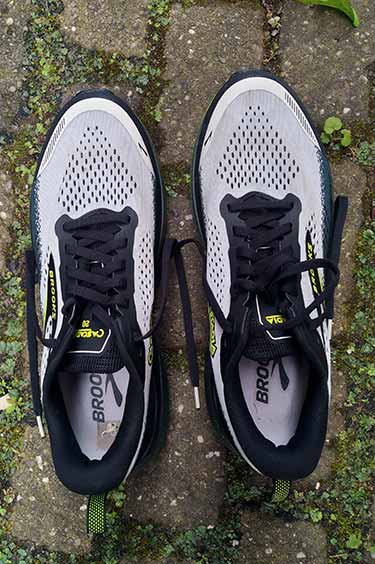 The Brooks Cascadia 20 is a well-cushioned trail running shoe. It has a lively, cushioned feel to the ride, making it suitable for road-to-trail use. It is better suited to hard-packed tracks and trails rather than muddy cross-country runs.
Quite a bit has changed in the 20th version of the Brooks Cascadia when compared to the previous version. The 6mm heel-to-forefoot drop has been maintained, but the stack height has increased by 4mm to 38mm in the heel and 34mm in the forefoot. The midsole foam has also changed. The Brooks Cascadia 19 used DNA Loft v3 as its midsole foam, which is designed to offer a cushioned, plush ride. The foam used for the midsole of the Cascadia 20 is DNA Flash v2, which is designed to be faster and more responsive and has previously been used in Brooks’ race/trainer-style road running shoes.
Both midsole foams are nitrogen infused, which means that they have been sealed to prevent air from escaping and grit and water from getting in. This makes the midsole more durable and also means it maintains its ride characteristics for the length of your run. So, the midsole won’t go soft and unresponsive just as your legs are getting tired at the end of a long run.
The change in stack height and midsole foam means that the Cascadia 20 has a firmer, more responsive feel to the ride compared with the previous version, and there is no feel for the floor. The lack of underfoot feel means that you can’t feel what you are standing on, so your feet can’t react to it. This means that you are reliant on the Cascadia 20 being able to absorb some of the roots and rocks on the trails, rather than you skipping over them, to maintain a smooth ride.
Despite the high stack height of the Brooks Cascadia 20, it now feels more like a trail running shoe rather than a softly cushioned road shoe in disguise. Even hard-packed tracks and trails are softer than a tarmac road, so you don’t need a soft, plush midsole in order for the shoes to feel comfortable and cushioned. The firmer, more responsive midsole of the Cascadia 20 allows the runner to pick up the pace more easily. The midsole is responsive enough to react to the force you put through it, allowing you to push on. The foam is also better on steep climbs, giving a firmer, more reactive base to push off from. On descents, the midsole doesn’t compress as much, making the Cascadia 20 more stable and faster than the previous version.
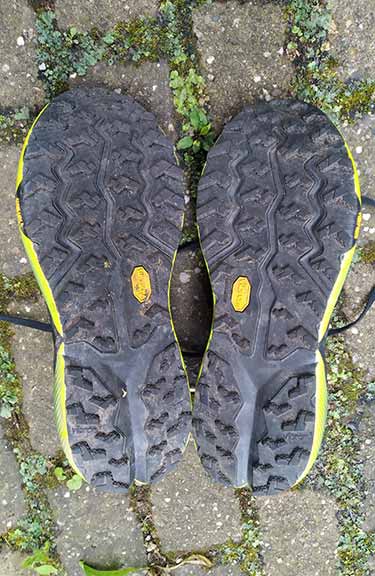 The width of the base of the Cascadia 20 has also been reduced. This is another improvement. The base of the Cascadia 19 offered a stable ride, which was fine on firmer tracks and trails, but once you got onto narrower tracks they became noticeably cumbersome. On single-track paths, the shoe often didn’t fit into the space on the path, making forward progress difficult. The Cascadia 20 is 1cm slimmer and noticeably rides these narrow single tracks much more easily. The DNA Flash v2 midsole foam is firmer and therefore more stable, despite the increased stack height, so there is no loss in stability. The base of the Cascadia 20 is still broad compared to more narrow, nimble, responsive trail running shoes.
The heel cup is a firm plastic designed to hold the foot inside the shoe. The inside of the heel cup is well padded, as is the cuff. This gives the Cascadia 20 a comfortable feel from the moment you put your foot inside the shoe. The tongue is also well padded, offering protection from the laces. The tongue isn’t fully gusseted, but it is attached to the base of the shoe to give a snug fit around the midfoot and to stop the tongue moving while running. The laces also thread through a tab on the outside of the tongue to prevent it from slipping to one side when running.
There is an extra lace hole at the top of the laces, which can be used to make the heel fit snugger or to butterfly lace the shoes. Part way down the laces is a piece of elastic that runs horizontally across them. This is there for the runner to push the bow and excess lace underneath once the shoes are tied. It keeps the laces out of the way, helping prevent them from becoming untied when running through thick undergrowth, for example.
The upper is made from an engineered mesh that is pliable and soft to the touch. The inside is smooth, with an open mesh on the outside.
The outsole rubber is now Vibram Megagrip, which is designed to offer good traction on wet and dry surfaces. The lugs are 4mm in depth and closely packed to put a larger surface area in contact with the ground, helping to offer good traction on smooth surfaces. In greasy conditions, the Cascadia 20 does provide some traction, but in the mud the closely packed lugs clog and they are not long enough to bite into the mud. The midsole is also too stiff to curve to the shape of the ground to maintain traction. This is why the Brooks Cascadia 20 is best used on harder tracks and trails.
 The fit is snugger than the previous version. The Cascadia 20 upper hugs the midfoot a lot tighter, holding you in the shoe. This makes the Cascadia 20 feel much more stable and comfortable on the trails. Unfortunately, the toe box has also been made snugger. This reduces the space that the toes have to spread and function inside the shoe, and it feels cramped in comparison to the previous version. Whether this is an issue will depend on the volume of your feet and whether you are used to having a roomy toe box.
Brooks running shoes are a similar length to Saucony, Altra, Topo and 361. If you use Hoka, New Balance, Karhu, Inov-8 or La Sportiva, then we would suggest trying half a UK size larger in Brooks. For example, a UK 11 in Brooks is a similar length to a UK 11.5 in Hoka. The Brooks Cascadia 20 is available in two widths for men and two widths for women.
Despite the increased stack height, the Brooks Cascadia 20 is lighter than the previous model. A men’s UK 8 weighs 299 grams and a women’s UK 5 weighs 275 grams.
Although the Brooks Cascadia 20 feels a bit less plush and cushioned on the tarmac stretch to get to my local trails, once on the trails it performs better than the previous version. The firmer midsole helps it respond better to the terrain and when changing direction. The narrower base allows the Cascadia 20 to ride a much bigger variety of terrain. On broken ground and when contouring, they are still a bit stiff and don’t take the curvature of the ground well, but the trade-off is a stiffer, more responsive shoe on climbs, and one that is stable on descents and rides well on hard-packed trails.
In summary, the Brooks Cascadia 20 has a new snugger-fitting upper, a narrower footprint, increased stack height and a firmer, snappier, more responsive midsole. It offers a different feel and ride, but one that is likely to feel like an improvement to most Cascadia wearers.
Alternatives to Brooks Cascadia 20
La Sportiva Prodigio 2: A wide fit with more volume in the toe box. A more flexible shoe which makes it better for more broken ground and running on a camber. Not as easy to cruise in on hard packed terrain. Similar level of traction. https://www.northernrunner.com/blog/la-sportiva-prodigio-2-review/
Altra Experience Wild 3+: A broad rounded toe box gives the feet the room to spread and function inside the shoes. Although they do have a slight rocker this isn’t a noticeable as on other shoes and so the ride feels very natural. As they aren’t as stiff they don’t cruise on hard packed terrain as well as the Cascadia 20 but, they do adapt to the surface better so ride better on rough ground. https://www.northernrunner.com/blog/altra-experience-wild-3-review/
Inov-8 Trailfly 2: A broad rounded toe box gives the feet the room to spread and function inside the shoes. More flexible than the Cascadia 20 makes it more adaptable on rougher or more challenging underfoot conditions. Doesn’t cruise on hard packed terrain as well as the Cascadia. Available in two width men’s and women’s. https://www.northernrunner.com/blog/inov-8-trailfly-v2-review/
Mount to Coast T1: A straighter big toe line and roomier toe box. Firmer ride. Traction at a similar level. https://www.northernrunner.com/blog/mount-to-coast-t1-review/
OMM Trail Shoe: A similar snug pointed toe box. Firmer more responsive cushioning. Midsole isn’t as flexible as some but, does adapt to terrain while also being stiff enough to all you to run quickly on hard packed tracks and trails. More feel for the ground allows you to be nimble. Available in two widths. https://www.northernrunner.com/blog/omm-trail-shoe-review/
361 Futura 3: A well cushioned trail shoe with a soft ride. Good traction although the lugs are too short for deep mud. More room in the toe box. Available in two width men’s and women’s. https://www.northernrunner.com/blog/361-futura-3-review/
Hoka Speedgoat 7: A narrow fit with a soft ride and pronounced rocker. Available in two width men’s and women’s. https://www.northernrunner.com/blog/hoka-speedgoat-7-review/
Scott Kinabalu Trail: Straight big toe line. Slight rocker. Traction a bit better and although they are cushioned, they do have more feel for the ground. https://www.northernrunner.com/blog/scott-kinabalu-trail-review/
Topo MTN Racer 4: A broad round toe box gives the feet the room to spread and function. Stiff so better for hard packed trails but, the lugs are well spaced and 5mm in length so they can cope with a bit of mud.
https://www.northernrunner.com/blog/topo-athletic-mtn-racer-4-review/
VJ Maxx 2: A much nimbler shoe with more feel for the ground however, the nitrogen infused midsole gives a bit of bounce which makes them cushioned on hard packed trails and short sections of tarmac. Good traction that is versatile enough for a bit of mud. Rounded toe box allows the feet the space to spread on impact and function inside the shoes. https://www.northernrunner.com/blog/vj-sport-maxx2-review/
Comments are closed here.