
OMM Trail Shoe Review
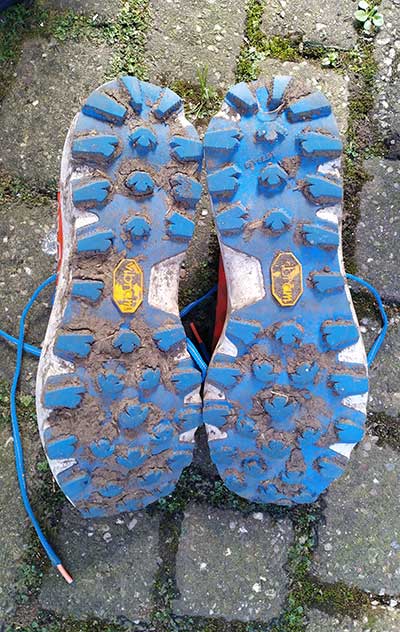 The OMM Trail Shoe is designed, just as the name suggests, for trail running. There are broadly two types of trail running shoes on the market: the oversized, soft midsole designed to compress and absorb roots and rocks for a smooth, cushioned ride, and the firmer, more flexible and highly responsive shoe that allows for greater ground feel. The latter helps the runner to move nimbly over obstacles and adapt to the contours of the terrain. The right approach depends on the terrain you run on most often and the type of feel you prefer.
Trail running shoes produced by British or Scandinavian brands tend to be firm, responsive and flexible, offering a high level of ground feel. This reflects the typical terrain in these regions, which often consists of softer, more broken singletrack, as well as open fell or moorland. American and many Continental brands, by contrast, tend to favour softer, more cushioned shoes, as their trails are often harder packed and drier.
Of course, this is a generalisation. All types of terrain can be found in all countries, and both styles of shoe can work across a range of conditions. What matters most is choosing a shoe that suits the terrain you run most frequently and the experience you want as a runner.
The OMM Trail Shoe sits firmly in the responsive category. This does not mean it feels harsh or lacks shock absorption, but rather that the midsole does not compress excessively on impact. You don’t sink into a soft platform; instead, you remain aware of the ground beneath you. This increased ground feel encourages quicker foot turnover, helping you stay light on your feet and more agile across changing terrain. The result is a faster, more controlled ride, where direction changes feel immediate and precise. This is a trail shoe designed with UK conditions in mind.
Shoes that prioritise ground feel and flexibility typically require a snug fit so that the foot moves with the shoe rather than inside it. The OMM Trail Shoe delivers a secure, close fit. For runners with wider feet, a wider version is available, designed to maintain that same secure feel. The heel cup is firm to hold the foot in place, while the padding around the heel and collar is sufficient for comfort without being excessive. This helps reduce water absorption in wet conditions.
 The tongue is notably soft and designed to mould comfortably over the top of the foot. A light strip of padding beneath the laces helps to reduce pressure. The tongue is secured by both a lace loop and internal straps that connect it to the base of the shoe, preventing movement when laced. This construction is similar to that used in the OMM Fell Shoe. However, it feels more natural here. Where the Fell Shoe initially felt stiff on steep climbs, this Trail Shoe is more flexible from the outset, likely due to the shorter 4mm lugs compared to the Fell Shoe’s deeper 8–11mm lugs.
My first run in the OMM Trail Shoe was a two-and-a-half-hour outing over mixed terrain, starting with a mile on tarmac before moving onto muddy singletrack along the River Derwent. Initially, the narrower toe box felt restrictive compared to more rounded designs. However, the straighter big toe line allows for a more efficient push-off, and the nimble, responsive feel works particularly well on narrow trails with roots and rocks. Cushioning remains comfortable on short road sections and firmer trails.
There is always a balance between flexibility and stiffness in a trail shoe. Too much flex can reduce propulsion, while too much stiffness can limit adaptability. The OMM Trail Shoe strikes this balance well. With a 27mm heel stack, it provides a good level of protection while maintaining ground feel. The 6mm drop supports a natural midfoot landing but remains comfortable for heel strikers.
The outsole features 4mm lugs made from Vibram Megagrip using Litebase construction. This reduces the thickness of the rubber base, allowing greater flexibility. Megagrip offers reliable traction on both wet and dry surfaces, while also being durable enough for occasional road use. Running a mile or so to reach the trails won’t significantly impact durability.
An EVA rock plate in the forefoot adds protection from sharp stones and debris.
Like the OMM Fell Shoe, the upper is highly durable and built to withstand abrasion from rocks and vegetation. Despite this, it remains soft and pliable, moulding comfortably around the foot when laced.
Despite its robust appearance, the OMM Trail Shoe is not heavy. A UK 8 weighs approximately 248 grams. The secure fit helps the shoe feel like an extension of your foot, contributing to its light and responsive ride.
In terms of sizing, OMM running shoes are similar in length to Brooks, Altra, Topo, 361, Mount to Coast and Saucony. If you typically wear Hoka, New Balance, La Sportiva or Inov-8, we would suggest trying half a UK size smaller to achieve a similar fit. For example, a UK 11.5 in Inov-8 is comparable in length to a UK 11 in OMM.
In summary, the OMM Trail Shoe is a well-balanced, versatile option for mixed terrain. It delivers a nimble, responsive ride while remaining comfortable across a range of speeds and surfaces.
Alternatives to OMM Trail Shoe
Hoka Speedgoat 7
A contrasting approach, with a soft, highly cushioned midsole and limited ground feel. The shoe relies on cushioning to absorb impacts rather than encouraging precise foot placement. A pronounced rocker aids forward momentum. Comfortable on tarmac and hard-packed trails, with comparable traction, though it requires more trust due to reduced ground feedback. Hoka Speedgoat 7 Review
361 Futura 3
A soft, cushioned ride with a rocker geometry. Performs well on hard-packed trails and tarmac but lacks agility on more technical terrain. It feels less responsive and not as fast as the OMM Trail Shoe. Traction is strong. 361 Futura 3 Review
Ronhill Reverence 2
A straighter big toe line provides a more natural fit without being as wide as Altra, Topo or Inov-8. Designed primarily for softer ground, the 7mm lugs limit performance on tarmac, where it can feel slower and less efficient than the OMM Trail Shoe. On trails, however, it delivers a similarly firm, responsive ride with a good balance of flexibility and stiffness, making it easy to run at pace. Ronhill Reverence 2 Review
VJ MaXx 2
A rounded toe box allows for natural foot movement, while the heel and midfoot fit remain snug. The upper is firmer and less pliable than the OMM Trail Shoe. Traction levels are similar, as is the overall versatility of the ride. VJ Maxx 2 Review
Scott Kinabalu Trail
A similar toe box shape with a softer, more cushioned ride, while still retaining some flexibility. The rocker geometry is present but less pronounced than in other models. It feels less responsive and slower compared to the OMM Trail Shoe. Scott Scott Kinabalu Trail Review
Brooks Cascadia 19
A cushioned, bouncy ride with minimal ground feel. The wider platform adds stability but reduces agility on narrow or technical trails. Best suited to hard-packed terrain. Available in multiple widths for both men and women. Brooks Cascadia 19 Review
Ronhill Freedom Ultra
Despite the name, this is a versatile trail shoe. It offers comfortable cushioning for tarmac while still maintaining some ground feel, making it suitable across a range of terrains. Ronhill Freedom Ultra Review
Inov-8 TrailFly v2
A broad, rounded toe box allows the foot to spread naturally. The TrailFly v2 offers a more flexible, natural ride, but with softer cushioning that reduces responsiveness compared to the OMM Trail Shoe. Available in two widths for both men and women.
Comments are closed here.