
Brooks Cascadia 18 Review
The Brooks Cascadia 18 is a trail running shoe designed to be versatile enough for broken ground while also providing sufficient cushioning for harder-packed trails. The fit and feel of the Cascadia 18 are quite similar to other Brooks shoes and resemble the feel of a road running shoe. This appeals to runners looking for a shoe that feels like their Brooks road running shoes but offers more traction and better adaptability to trail contours.
 Brooks shoes are known for their high degree of step-in comfort, and the Cascadia 18 is no exception. Many trail shoes have less padding around the heel and cuff to reduce weight from water absorption, but this can sacrifice the cushioned feel found in road running shoes. The Cascadia 18 features a well-padded heel cup and cuff. The tongue is not as heavily padded as on many of their road running shoes, but it still provides good protection from the laces and adds to the overall comfort when stepping into the shoes.
The laces on the Cascadia 18 are spaced further apart than those on Brooks’ road running models. This design allows the upper to pull over the foot more effectively, creating a more locked-in fit. It helps prevent the foot from moving inside the shoe when running on a camber, over broken ground, or down a steep descent. There is an additional lace hole that allows you to pull the heel cup in further for a snugger fit. You can also use this extra hole for a butterfly lacing technique. Partway down the tongue, there is a piece of elastic that runs horizontally across it, allowing you to tuck the laces away, which prevents them from getting untied in the undergrowth. This feature also keeps the laces cleaner, reducing the chance of them becoming too muddy, which can hinder staying tied in future runs.
The tongue is gusseted to help prevent debris from entering the shoe and to reduce the chance of the tongue shifting during your run.
A rand runs around the base of the shoe and forms the toe bumper, which reduces abrasion to the upper and protects the toes. The toe bumper is not too rigid, so it’s unlikely to dig into your toes during long, steep ascents while still offering adequate protection.
The toe box has a straight big toe line, allowing the smaller toes to move freely, as the big toe is not under tension like it would be in a more pointed toe box. This design enables your feet to spread better, providing improved balance and function within the shoe, leading to greater propulsion. A straighter big toe line also makes the toe box feel roomier. During longer runs, your feet swell, and the roomier design allows for more foot function.
The main difference between the Cascadia 18 and the Cascadia 17 is the flexibility in the midsole. The Cascadia 18 features what Brooks calls an “Adapt midsole,” which moves medially and laterally to absorb camber and some obstacles on the trail. This design allows for a smoother run over broken ground, reducing the risk of twisting an ankle. While the Cascadia 17 had this technology, it lacked sufficient flexibility and felt like a stiff, cumbersome road shoe on single-track trails. The Cascadia 18 is quite different; it’s not as nimble as a fell or cross-country shoe but is a step up from a rigid road shoe. I felt confident running over a freshly ploughed farmer’s field (there is a path, it has just been ploughed) without risking a twisted ankle. Similarly, I made forward progress over thick tufty grass without issues. On firmer tracks and trails, a little stiffness provides support and guides you through the gait cycle, ensuring good forward momentum. Therefore, the balance between making a trail shoe flexible enough for rough, broken ground and stiff enough for firmer tracks depends on the runner and the terrain they typically encounter. My easy runs involve very mixed ground, ranging from tarmac to muddy fields. I found the Cascadia 18 well-equipped to handle this variety of trail terrain.
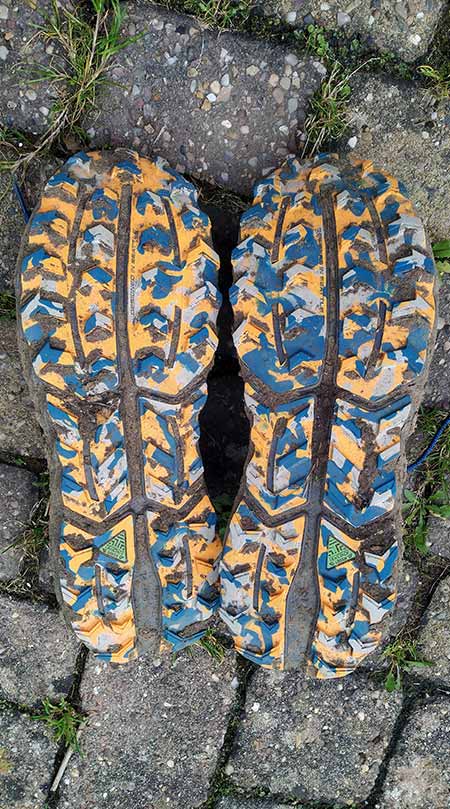 The 4mm lugs grip nicely into soft ground but are hardly noticeable when running on harder trails or tarmac. Brooks’ Trailtac rubber offers a good level of traction on wet and dry rock while remaining durable for regular use.
With an 8mm heel-to-forefoot drop, the Brooks Cascadia 18 is better suited for heel strikers. It has soft cushioning in the heel and firmer support in the forefoot, providing a good positive push-off while maintaining some ground feel. The heel height was not so pronounced that, as a midfoot striker, I couldn’t enjoy running in these shoes. However, I did find the forefoot cushioning to be quite firm initially on tarmac, though it softened after a few runs and became more comfortable.
Brooks shoes are similar in length to Saucony, Topo, and Altra. If you typically wear Hoka, La Sportiva, Inov-8, Karhu, Scott, or VJ, I suggest trying half a UK size smaller to achieve a similar fit. The Brooks Cascadia 18 is available in two widths for both men and women to ensure the perfect fit.
The Brooks Cascadia 18 also comes in a GTX or Gore-Tex version, featuring a waterproof upper made from Gore Invisible Fit. This design integrates Gore-Tex material into the upper rather than using a Gore-Tex “bootie” inside a mesh upper. This construction keeps the upper soft and flexible like a mesh upper, maintaining the same fit. The Brooks Cascadia 18 GTX would be an excellent option for winter, as the upper keeps water out and is less air-permeable, providing warmth. In our experience, when the air temperature rises above 10 degrees, shoes with a waterproof upper can become too warm, causing your feet to sweat inside. Therefore, they are best used as winter footwear.
In summary, the Brooks Cascadia is a versatile trail running shoe designed for everyday trail use—a durable workhorse. If you’re accustomed to running in Brooks Ghost or Brooks Glycerin, the Cascadia will offer a similar fit and feel, with a high heel-to-forefoot drop and exceptional step-in comfort.
Other Considerations
NNormal Tomir 2.0: The toe box is more pointed and has less height which makes it less roomy and not as comfortable over distance. Grip is comparably good on similar terrain. The Tomir 2.0 midsole has a lot more bounce which takes away a lot of the ground feel. https://www.northernrunner.com/blog/nnormal-tomir-2-review/
Inov-8 TrailFly: Available in two width Men’s and Women’s. The toe box is broad and rounded to give the feet room to function inside the shoes. The midsole is more flexible and there is more ground feel. Comparable grip. https://www.northernrunner.com/blog/inov-8-trailfly-review/
Altra Experience Wild: Not as much traction on softer terrain makes these not quite as versatile. A lower drop and slight rocker makes the ride a bit different too. The toe box is more rounded and slightly broader to allow room for your feet to spread on impact. https://www.northernrunner.com/blog/altra-experience-wild-review/
Scarpa Goldengate 2: A very similar feel to the cushioning. The traction is as good. The Goldengate is slightly stiffer through the midfoot so not quite as comfortable on really broken ground but, the rocker/curve in the midsole makes them easier to cruise a long in on harder tracks and trails. https://www.northernrunner.com/blog/scarpa-golden-gate-atr-2-review/
Scott Kinabalu: Not as versatile. The stiffness through the midsole makes the Kinabalu as shoe for firmer tracks and trails only. The toe box has a similarly straight big toe line and a similar amount of room in the toe box. The cushioning level and midsole thickness is much greater which reduces the feel for the ground that you get with the Cascadia 18. https://www.northernrunner.com/blog/scott-kinabalu-3-review/
New Balance Hierro v8: Available in three width Men’s and two width Women’s. Not as grippy on softer terrain but has similar traction on firmer surfaces. A similar heel to forefoot drop. The Hierro cushioning is slightly softer. https://www.northernrunner.com/blog/new-balance-hierro-v8-review-fresh-foam-x/
VJ MaXx 2: A more rounded toe box but, with similar width and volume to the Cascadia 18. The traction is similarly good on soft ground. The Maxx 2 sheds mud from the cleats easier as the shoe is a bit more flexible it also rides better on broken terrain. It has the feel of a nimble trail shoe but, the cushioning of something more stacked. The rubber offers better traction on wet rock. https://www.northernrunner.com/blog/vj-sport-maxx2-review/
Topo Athletic MTN Racer 3: Like all Topo shoes the MTN Racer 3 has a broad rounded toe box to allow the space for your feet to function. There is less volume in the toe box than other Topo shoes designed for harder surfaces but, more than there is in the Cascadia 18. The outsole has a similar level of traction however, the MTN Racer 3 sheds the mud more easily from the cleats. https://www.northernrunner.com/blog/topo-athletic-mtn-racer-3-review/
Altra Timp 5: A broad rounded toe box and zero drop allows for a more natural midfoot landing and better foot function. This gives the Timp 5 a nimble feel despite the thick midsole. The lugs aren’t as aggressive as on the Brooks Cascadia 18 so they don’t bite as well into soft ground but, offer similar traction on harder surfaces. https://www.northernrunner.com/blog/altra-timp-5-review/
La Sportiva Akasha II: The Akasha II has less volume in the forefoot and is initially stiffer until they are broken in a bit. After this point they adapt to the trail nicely. The lugs are deeper and more pointed under to forefoot and give better traction on softer ground and shed the mud better. The lugs at the rear are flatter and don’t offer quite the same traction as the rear lugs on the Brooks Cascadia 18. https://www.northernrunner.com/blog/la-sportiva-akasha-ii-review/
Karhu Ikoni Trail: A similar toe box shape allows for a positive push off. The lugs are versatile enough for tarmac and some soft trail. The cushioning is softer than the Cascadia 18 and they don’t have the same ground feel. https://www.northernrunner.com/blog/karhu-ikoni-trail-review/
Comments are closed here.