
Karhu Ikoni Trail Review
This week, a brand that continues to impress in-store at Northern Runner Newcastle and their just-launched trail shoe. It’s the Karhu Ikoni Trail review. After being very impressed with the feel of the Karhu Fusion, which served me well as an everyday training shoe (click here for the Karhu Fusion review). I was looking forward to seeing what Karhu could do with a trail shoe. And they didn’t disappoint.
 At first glance the Karhu Ikoni Trail looks like a rugged, durable trail shoe. When you put your foot in the shoe you can instantly feel the anatomical fit, like it was made to cradle your foot. Your heel sits comfortably with a locked in feel, whilst the extra room in the toe box allows your foot to function naturally. The big toe is nice and straight to allow a natural push off during running. The arch of the foot feels supported but not restricted, so your foot is allowed to naturally flex at the arch. When your feet can work naturally it results in less stress, which means you have less chance of getting niggles and aches, so you can enjoy more miles.
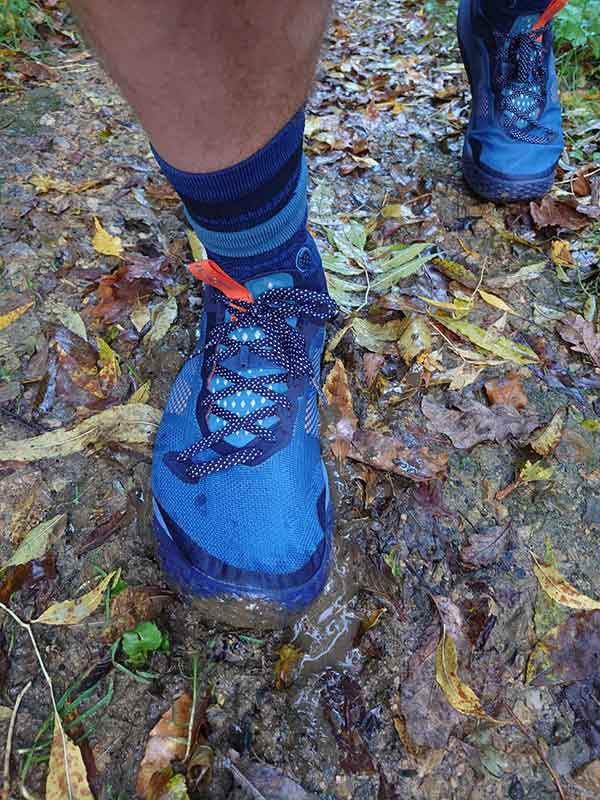
The tongue is thin, snug, and gusseted meaning less chance of debris from the trails getting into the shoe. On the outside of the tongue, part way down, there is an elastic strap that runs horizontally across the tongue. This snag strap is there so you can tuck your laces underneath it after you have tied up your shoes. This stops them from getting caught in the undergrowth and getting untied during your run.
The shoe has what Karhu describes as a belay lacing system and a 7-point heel lock. This effectively pulls the upper in around the heel to give a secure fit. The laces are slightly asymmetrical with an extra eyelet that goes into the toe box. This allows you to pull the toe box in if you don’t want to have as much freedom for your toes. It’s handy as on hard-packed trails where you want your feet to have the space to be able to function. As the ground gets more broken or when you are running on a camber a snugger fit holds the foot better so that your foot doesn’t turn inside the shoes. How snug depends on the volume of your feet and how much foot function you have. Being able to adjust the volume in the forefoot makes the shoe more versatile.
The toe bumper offers enough protection for the toes from tree roots and rocks without effecting the flexion of the shoes.
The outsole is made of a rubber designed to grip on wet surfaces. Coming from Finland, Karhu have had enough practise on wet woodland trails to test out the traction of the outsole! The lug pattern is rugged with lugs pointing forward and backwards to give good traction while ascending and descending. The lugs are large enough to be durable but still pointed enough to bite into soft ground. The lugs are about 4mm in length, which makes them not long enough for deep mud but they bite well on greasy muddy single tracks quite well.
The Karhu Ikoni Trail has a stack height of 28mm in the heel and 23mm in the forefoot. Giving them a heel to forefoot drop of 5mm. The contoured shape of the midsole makes your foot feel cradled in the shoes. They don’t feel flat but at the same time you aren’t aware of any heel lift. The AeroFoam midsole feels softer and more flexible than the midsole used for the Karhu road shoes. This gives good underfoot protection from rocks and roots while being flexible enough to take the shape of the ground so that you don’t get thrown around by the terrain.
 Karhu was the first brand to use cushioning in running shoes in addition to the EVA midsole. What they discovered is that their ‘Air’ cushion made the runner bounce up and down rather than go forward. In 1986 they developed what they currently use–a Fulcrum. This helps maintain an upright posture and keeps your feet moving back, so you go forwards. This is like the ‘rocker’ used in a lot of other brands (Hoka, Scott, some Brooks shoes etc..). The difference that I found when running in the Karhu Fusion is that the Fulcrum encourages you to lift your heel up rather than ride the curve of the shoe, like you would in shoe with a rocker. I find that this makes me much lighter on my feet and lean forward less at the waist as I get tired. The Fulcrum in the Ikoni Trail is in a slightly different place but the effect is the same and I found that I was picking my feet up as I ran along rather than putting them down. The pivot point is closer to the toes, which makes the Ikoni Trail feel less stiff and more comfortable on steep ascents. The toe of the shoe is turned up to give a good toe spring.
I sized up by half a UK size compared to my usual size. This is the same sizing as the Karhu road shoes and the same size as I use in Hoka, La Sportiva and Scott running shoes.
To get to my local trails I run 2 miles on the road. The cushioning on the Ikoni Trail is very impressive, it just takes the impact so well. My feet felt protected from the ground, yet stable. I was in control of the shoe rather than at the mercy of a shoe that was too soft and squishy. The 5mm drop allowed my feet to land with a midfoot strike. Once I hit the trails I was in my element. The grip that was a little slippery (naturally) on the pavement suddenly became like an off-road bike tyre. It seemed to grip everything. Hard packed trail, gravel, wet grass and sloppy mud. Going uphill was made easy by the impressive M-lugs and T-lugs as they just dug in and clawed their way to the top. Obviously, I had to try descending and they were magnificent going down very muddy grass tracks. I didn’t slip once even on a tight corner and a steep camber. Back onto the firmer packed trails and gravel paths the grip just kept me in control, yet perfectly cushioned. You can tell the Finnish have similar terrain to us. I’d be quite happy to run these through the snow too. You can feel the cushioning on your toes as you push off and the pivot point of the fulcrum just tips you forward to put you in the optimal position. I could run some seriously long miles in this shoe. On my way back home the pavement section didn’t seem slippery anymore, which meant I could keep the pace up. As with the Karhu Fusion road shoe, I find that I look forward to running in the Ikon Trail and my form improves each time I run in them.
Like the Karhu road shoes, the Ikon Trail isn’t a “built for speed” trail running shoe. That doesn’t mean that they hold you back and you can’t clip along in them. It just means that the focus of the shoe isn’t ‘making you go quickly’. They are a very comfortable, functional trail shoe designed for putting the miles in on a mixture of terrain.
Here is a link to our brief history of Karhu which will give you some more information on the brand:
https://www.northernrunner.com/blog/6843-2/
Other Considerations
Topo Ultraventure 2: These have a similar roomy toe box and level of cushioning. The Ikoni trail provides more feeling of propulsion. Whereas the rounded toe box of the Topo’s encourages more foot function. Here is our review: https://www.northernrunner.com/blog/topo-athletic-ultraventure-2-review/
Altra Timp 4: Zero drop and a rounded toe box. The toe box doesn’t feel as roomy as it does in the Ikon Trail. The Timp 4 has a more natural ride whereas the Fulcrum in the Ikoni Trail helps you maintain posture. Here is our Timp 4 review:
https://www.northernrunner.com/blog/altra-timp-4-review/
La Sportiva Akasha 2: The cushioning is slightly firmer and there isn’t as much room in the toe box. The rubber is softer and more grippy on wet surfaces but, not as durable. Here is our review:
https://www.northernrunner.com/blog/la-sportiva-akasha-ii-review/
Brooks Cascadia 16: A higher heel to forefoot drop. The grip doesn’t bite as well on soft ground but, rides a bit better on the road. The cushioning is as soft but, feel more bottomless and less responsive. Here is a link to our review:
https://www.northernrunner.com/blog/brooks-cascadia-16-review/
Saucony Xodus Ultra: A higher drop. Cushioning is firmer. The outsole doesn’t bite as well in the mud. Here is our review:
https://www.northernrunner.com/blog/saucony-xodus-ultra-review/
Hoka Speedgoat: A faster feeling shoe. Much more pointed toe box. The rocker helps keep your cadence high and you running with an upright posture. The grips don’t bite as well in soft mud in our experience.
https://www.northernrunner.com/blog/hoka-speedgoat-5-vs-speedgoat-4/
New Balance Hierro v7: A similar type of shoe in that it is a daily training shoe. Similar soft cushioning. Feels more like a road shoe than the Ikoni Trail and the outsole doesn’t bite as well into the mud.
https://www.northernrunner.com/blog/new-balance-hierro-v7-review/
Icebug Capra: A similar rounded toe box and straight big toe. Not as much volume in the toe box. The cushioning is firmer and more responsive. The lugs are longer and grip better in the mud. Here is our review:
https://www.northernrunner.com/blog/icebug-capra-review/
Comments are closed here.