
Scott Supertrac Amphib Review
Let’s start the Scott Supertrac Amphib review with the basics–what it was designed for. The Scott Supertrac Amphib has capitalised on the versatility of the Scott Supertrac RC 2 midsole and outsole (although the outsole does have a few tweaks) and the upper has been replaced with KPU to drain well and repel water, so it doesn’t get any heavier even when saturated. This makes the Scott Supertrac Amphib the ideal shoe for any running events where you come in contact with water. For example swimruns, obstacle course racing, orienteering, fell running, cross country racing, exploring river banks or coast lines.
The Scott Supertrac RC was launched as a lightweight trail racing shoe back in January 2017. This popular shoe was upgraded to the Scott Supertrac RC 2 three and a half years later in June 2020. The improvements to the Supertrac RC where well-received by runners and the Supertrac RC 2 has remained a popular shoe. The Scott Supertrac Amphib doesn’t replace the Scott Supertrac RC 2, it just makes it more suitable for use in environments where you will encounter a lot of water. If you are running purely on rough trails, moorland or mountain paths the Scott Supertrac RC 2 will still be the better option. The Scheoller upper that the Supertrac RC 2 has is more abrasion resistant, so less likely to get damaged by rocks or coarse heather. The Scheoller upper also offers more protection for your foot in these harsh trail environments.
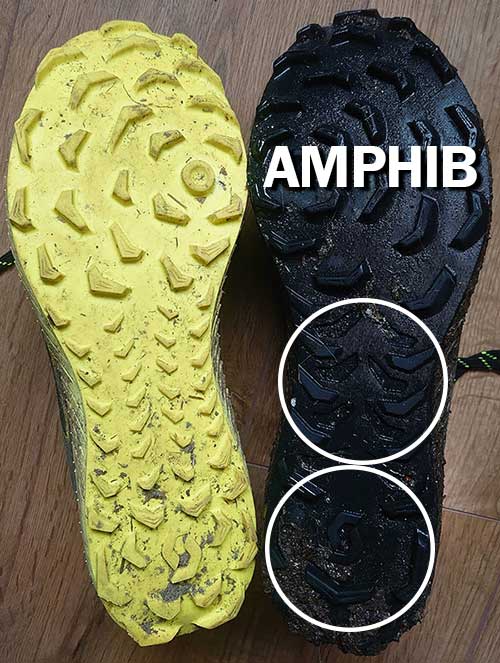
The outsole of the Scott Supertrac Amphib uses a similar outsole pattern to the Supertrac RC 2. The lugs are 6mm in length and strategically positioned to give a good level of traction on broken ground whilst reducing the chance of getting clogged up. The outsole consists of a mix of different sizes lugs placed at different angles to give traction whilst both climbing and descending. The rubber is sticky and gives good traction on wet rock and other wet surfaces, which is a must if you’re exploring rivers and streams, tackling obstacles and so on. It is still durable enough for a mix of hard packed tracks and softer ground use. Here is a link to our Scott Supertrac RC 2 review, which shows a picture of the outsole of my original Supertrac. They had done well over 500 miles at this point: https://www.northernrunner.com/blog/scott-supertrac-rc-2-0-review-trail-fell-running-shoes/.
 Outsole Grip
The Scott Supertrac Amphib lugs are slightly larger and there are lugs under the midfoot. The larger lugs are designed to bite better into soft muddy ground and the lugging under the midfoot is designed to give extra traction while climbing obstacles in OCR events.
The outsole is versatile enough to give good traction on wet ground. I wouldn’t recommend these shoes for cross country racing because the midsole isn’t flexible enough to take the shape of the ground and the studs don’t shed the mud as well as a cross country spike. However, they do give good enough traction to deal with short sections of muddy ground like you would encounter in a fell or trail race. The studs also ride perfectly well on hard packed tracks. This means that you don’t feel the studs or feel like you are running on jelly which is the feeling you get when running on firm surfaces in fell shoes with long pointed studs. The longer lugs on the outsole of the Scott Amphib mean that there is a good surface area of sticky rubber in contact with the ground. During our review we got a good secure feeling on firmer ground and the shoes didn’t slide even on tarmac, which often happens when using shoes with long pointed studs. Even when the studs are made of a very sticky rubber. This is due to the small surface area in contact with the ground. The larger surface area in contact with the ground on the Scott Supertrac Amphib outsole helps reduce the chance of this happening considerably.
Shoes that are very flexible mould to the shape of the ground well and are the best type of shoes for soft or broken ground. However, when you get onto anything firmer they don’t ride the ground very well. The midsole of the Scott Amphib has some welcomed stiffness to help give you some propulsion on harder surfaces but has enough flexibility in the forefoot to allow the shoe to mould to the shape of the ground. It’s one of the assets that makes these shoes effective on lots of different surfaces.
Low Drop & Rocker
The midsole is made from AeroFoam+ and is 22.5mm in the heel and 17.5mm in the forefoot. This gives a low heel to forefoot drop of 5mm. This low drop makes the Scott Supertrac Amphib feel very stable on rough ground. The midsole is also slightly curved. This creates a ‘rocker’ which on Scott running shoes is known as e-Ride. This is designed to help the runner maintain a higher cadence, with their foot landing under the centre of gravity. This encourages a more upright posture that makes you lighter on your feet. This not only helps you run quicker but makes you able to run over broken or muddy ground more effectively. If you lean forward at the waist, which a lot of runners do (especially as they get tired) you sink into the ground. In effect you are digging a whole in the ground rather than ‘gliding’ over the top of it. E-Ride encourages you to lift your feet off the floor rather than push against the floor, keeping that momentum.
The rocker or curve to the midsole isn’t very noticeable and the Supertrac Amphib is still quite flexible in the forefoot for good purchase on the ground and good foot function. However, the rocker is still very effective. It is most noticeable when you move from soft muddy ground to firmer tracks. The current bout of wet weather has made the fields down by the river in Shotley Bridge very wet and muddy. When you step off the muddy fields the rocker in the Supertrac Amphib helps you get straight back into a quick cadence that you can really feel. Other grippy shoes that I have used on the same ground haven’t given me the same ‘push on’ when I step back onto firm trails. This is what made the Scott Supertrac RC 2 such a popular shoe. It is great on soft and hard ground, which means that it functions really well on trails that can have a mixture of wet and dry terrain, broken ground and hard packed. They even have enough cushioning to feel comfortable for short sections of tarmac.
Supertrac Amphib vs. Supertrac RC 2
The larger lugs on the outsole of the Scott Supertrac Amphib do feel like they provide better traction in the mud than the Supertrac RC 2. To determine this I did try one of each, on each foot! The original Supertrac RC has lugging under the mid foot. This was removed on the Supertrac RC 2 because is caused the mud to clog in that area. This is essentially because of the lack of flexibility in that area. The Supertrac Amphib has these lugs under the midfoot but they are well-spaced out to reduce clogging and I haven’t experienced any clogging during the Supertrac Amphib review. However, it has been very wet in March while I have been reviewing these shoes and the mud is almost liquid in places rather than a sticky clay. If you are using the Amphib for climbing over wooden obstacles in OCR races, stepping over tree routes next to river banks or working your way around the coastline on wet rocks then the lugs in the midfoot will improve the traction.
Toe Box & Upper
The Supertrac Amphib has the same straight big toe line that the Supertrac RC 2 offers. This allows more foot function, which helps when running on difficult broken terrain. It also helps get a positive toe-off when trying to run quickly on firmer terrain. The upper is akin to a mesh with a rubber covering. Essentially it is a mesh designed to let water flow in and out of the shoes. The upper doesn’t take on any water so the shoes won’t get much heavier even when saturated. The insole is glued into the shoe so that it doesn’t move around even when the shoes are saturated. There is less volume in the upper of the Supertrac Amphib than there is in the Supertrac RC 2. This means that it doesn’t have quite the same height in the toe box and fits a bit snugger around the foot. The tongue isn’t gusseted so no water can get trapped in the folds of the tongue. I didn’t see any issues with this during my review miles. The tongue stays in place even when contouring due to the snug fit to the upper.
The sizing was the same as in all my other Scott shoes. Scott is a smaller fitting brand similar in length to Hoka or New Balance. If you use Brooks then I would suggest trying half a size larger in Scott shoes to get a similar length. The Scott Supertrac RC 2 and the Supertrac Amphib are similar in weight, with the latter coming in a tiny 10g heavier.
In Summary
The Scott Supertrac Amphib has taken the ride and versatility of the Scott Supertrac RC 2 and improved on these for use in wet conditions. The grip feels better in the mud and the upper is lighter and designed to shed the water. Which one suits you best depends on your main use for the shoes. If you are on the moors or in the mountains then the added protection and abrasion resistance of the Supertrac RC 2 is likely to be a better option. If you are running over muddy farmers fields and participating in OCR events then the Supertrac Amphib is likely to be the shoe to try.
Other Considerations
La Sportiva Cyklon is 8mm from heel to forefoot. More flexible in the forefoot. A more protective over with a built in gaiter to reduce the chance of getting debri in the shoes. The Boa fastening also stops the problem of muddy laces coming untied. Not as good at shedding water so probably not as good a shoe for Swin/Run events. Here is a link to our review for more information: https://www.northernrunner.com/blog/la-sportiva-cyklon-review-boa-lacing-system/
NVii Ultimate: A firm feeling responsive shoe. Not as versatile with a very fast feel. The sock type upper gives a very snug fit. Here is a link to our review for more information: https://www.northernrunner.com/blog/nvii-ultimate-review/
Inov-8 X-Talon 255 and X-Talon 212: Like the NVii Ultimate these aren’t as versatile as the Supertrac Amphib as they have less cushioning. They are more flexible with longer studs so for use in cross country racing or fell racing they would offer more traction. The X-Talon 255 is made on Invo-8’s standard last which is broader than the fit of the Scott Amphib. The X-Talon 212 is made on Inov-8’s precision last which is a narrow snug fit and has less room than the Scott Amphib. https://www.northernrunner.com/inov8-m6/x-talon-t131
Walsh PB Trainer: The original Fell Running shoes and still made in Bolton, Great Britain. Like the NVii Ultimate and X-Talon they aren’t as versatile. They are best kept for softer terrain. https://www.northernrunner.com/walsh-m8
VJ Sport Xtrm 2: A Scandinavian brand like NVii the VJ Xtrm 2 offers a good level of traction on soft ground and has a durable enough upper for use in the Mountains. The pointed studs don’t ride as well on firmer surfaces like all pointed studs. So, they aren’t as versatile as the Scott Supertrac. https://www.northernrunner.com/search/xtrm
Comments are closed here.