
New Balance Fresh Foam X Hierro v9 Review
 The New Balance Hierro v9 has evolved from an everyday trail running shoe into one that offers a much higher level of cushioning, making it suitable not just for daily trail runs but also for ultra-distance events. The stack height of the Hierro v9 is 42mm in the heel and 38mm in the forefoot. This is very similar to New Balance’s road running shoes like the 880v13, 1080v14, and More v5—which might make you think the Hierro v9 is just a road shoe in disguise. However, there are a few distinct differences that firmly place the Hierro v9 in the trail running category.
The foam used in the midsole is New Balance’s Fresh Foam X, the same compound used in their road models. However, the density of the foam is different. The Fresh Foam X in the Hierro v9 features a softer top section to deliver initial step-in comfort, paired with a firmer base to enhance stability and protect the feet from rocks, thorns, or other hazards commonly encountered on trails. While the top section of the midsole is soft, it’s not as plush as that of many road running shoes. It feels cushioned but firm on tarmac initially, though it has softened a bit after 100 miles of mixed road and trail use.
As with many shoes featuring a high stack height, the runner’s foot sits within the midsole. This design enhances stability and makes the rocker more effective at guiding the runner’s gait—as your foot follows the motion of the shoe. The low 4mm heel-to-forefoot drop helps reduce heel striking and encourages a more centered landing position under your body, improving balance and control, especially on broken or cambered trails.
Due to its height and relatively soft midsole, I initially thought the Hierro v9 would be suited only to roads and hard-packed trails. It has proven to be more versatile than expected. I tend to land midfoot, and because Fresh Foam is made up of lots of small bubbles—larger ones in the heel and smaller ones in the forefoot—I tend to miss the softer rear section. That works for me, as I prefer a slightly firmer feel and better ground feedback. Notably, there’s very little compression at impact. The closest road model from New Balance would be the More v5, which is significantly softer under the midfoot and allows more compression, leading to a more relaxed, less agile ride. That’s fine on the road, but on uneven trails where the camber constantly changes, you need a shorter, quicker, nimbler stride—something the Hierro v9 surprisingly allows for despite its maximal look.
The rocker or curvature in the midsole is designed to keep your stride moving forward and prevent you from sinking into the cushioning. It promotes a more upright posture and helps keep you light on your feet. One minor downside is that, on certain downhill gradients, the rocker can pull you downhill slightly, rather than allowing a completely natural gait. This isn’t unique to the Hierro—it’s a common trait in all shoes where the foot sits within the midsole and the rocker is engaged. Fortunately, the rocker in the Hierro v9 is quite subtle, so the downhill effect is minimal, just enough to be noticeable.
The thick, cushioned midsole is meant to behave like a mountain bike tyre. Since you can’t feel much through the foam, you rely on the shoe to absorb the terrain and maintain traction. The midsole is soft enough to absorb sharp rocks, flex over tree roots, and adjust to uneven surfaces, allowing you to run confidently down rough bridleways without fearing a twisted ankle from a stiff platform.
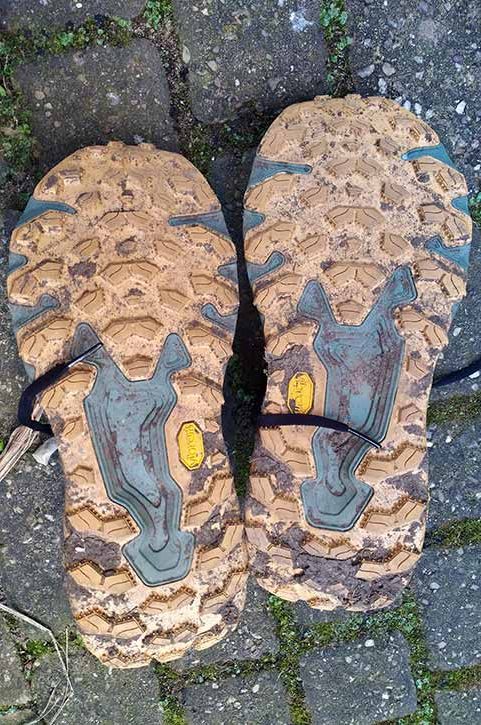
The outsole uses Vibram MegaGrip, a sticky rubber compound that balances grip and durability across wet and dry conditions. The 4.5mm lugs are flat with a broad surface area, and the midsole compresses enough to keep more of the sole in contact with the ground—great for hard-packed trails, tarmac, and dry single track. However, the shoe struggles in really muddy conditions. For mud, you’ll be buying a shoe with more ground feel and flexibility to adapt your stride and shed debris. The cushioning dulls feedback and the outsole doesn’t flex much, so the lugs tend to clog. The other area where the Hierro v9 isn’t ideal is on narrower single track trails, where the supportive wider base can be too wide to fit into narrow ruts worn into the ground, making it harder to maintain momentum. This might get frustrating in a race if things get narrow and you want to be nimble. Still, most trail ultras worldwide take place on wide forest paths or open trails, so this isn’t a deal-breaker for many runners. In the UK, we’re lucky to have thousands of miles of public footpaths winding around farms, through woods, and alongside rivers—how much of this style of trail is in your weekly routine will likely influence your choice of trail shoe. It’s a minor issue.
The upper of the Hierro v9 feels plush from the moment you step into it. It’s a shoe you can wear daily for your runs with no break-in needed. The padding around the collar, heel tab, and tongue is soft and comfortable. While some trail shoes strip back the upper padding to avoid retaining water, New Balance has gone for everyday comfort instead. The tongue is gusseted to prevent grit entering the shoe, and the laces are threaded through a tongue loop to stop it sliding off-centre while running.
The fit is snug through the heel and midfoot, with adequate—though not generous—room in the forefoot. Fortunately, the Hierro v9 comes in three width options for men and two for women, so runners can choose a wider fit if needed. The secure fit helps lock your foot inside the shoe’s midsole cradle, and I didn’t experience any foot movement on cambered or broken terrain. The toe bumper is solid enough to offer good protection up front. An additional lace hole allows for a snugger heel fit or butterfly lacing if needed.
New Balance running shoes are similar in length to models from Hoka, Karhu, La Sportiva, and Scott. If you normally run in Brooks, Saucony, Topo, 361, or Altra, you might want to try half a UK size larger in New Balance to get a similar fit.
In summary, the New Balance Hierro v9 is a significant departure from earlier versions. It delivers comfort and cushioning for long trail efforts while improving traction and stability. It still works well as a road-to-trail or daily trail option, and although it’s less effective in deep mud or tight single track, it’s a solid all-rounder for the majority of trail conditions.
Other Considerations
Inov-8 TrailFly: A rounded toe box gives the feet the rom to function. There is a lot more ground feel which might feel a little under cushioned for some runners using the shoes for Ultra’s. However, it worked fine as a road to trail shoe for me. Available in two width both with a roomy toe box. Traction is good for a 4mm long lug and they feel good on single track and technical trails. https://www.northernrunner.com/blog/inov-8-trailfly-review/
Topo Ultraventure 4: A broad rounded toe box gives the feet the room to spread and function. The traction isn’t as good and is better used on hard packed trails. The cushioning is firmer to stimulate the feet to spread and function. https://www.northernrunner.com/blog/topo-athletic-ultraventure-4-review/
Altra Timp 5: A broad rounded toe box and zero drop promotes a more natural ride and gives the feet room to spread and function inside the shoes. The ride is cushioned. Traction is only suitable for hard packed tracks and trails. https://www.northernrunner.com/blog/altra-timp-5-review/
361 Futura 2: A critical foam gives the midsole a very soft and bouncy feel. This midsole is much thinner than the Hierro’s but does a similar job of absorbing the rocks and routes on the trail. The lugs are longer and more effective on softer trails as they are more pointed and the shoe has more flex so sheds the mud easier. https://www.northernrunner.com/blog/361-futura-2-review/
La Sportiva Prodigio: The training version of the La Sportiva Prodigio Pro which is La Sportiva’s race ready Ultra shoe. The Prodigio has a firm feel to the cushioning which gives it a nimble ride. Not as grippy on softer trails. https://www.northernrunner.com/blog/la-sportiva-prodigio-review/
Hoka Mafate Speed 4: A similar high stack with long lugs that bite into soft ground. They ride well on a variety of trails but, like the Hierro do tend to collect the mud and have a wide base that struggles on single track. https://www.northernrunner.com/blog/hoka-mafate-speed-4-review/
Ronhill Freedom Ultra: A straight big toe line in the toe box gives the toe the room to spread and function in the shoes. The nitrogen infused midsole is firm but, has a subtle bounce. The rocker doesn’t pull you down the hill and they feel a lot nimbler. The lugs aren’t as long. https://www.northernrunner.com/blog/ronhill-freedom-ultra-review/
VJ XTER: A hydrogen infused midsole gives the XTER a bit of bounce. The cushioning is quite soft. Traction is at a similar level to the Hierro. They ride better on single tracks but they aren’t a nimble feeling shoe. https://www.northernrunner.com/blog/vj-xter-review/
NNormal Tomir 2: A hydrogen infused midsole gives the Tomir 2 a very bouncy ride which takes away from the feel for the ground. The lugs offer good traction on soft trail and they do work on single track. The toe box has a straight big toe line which is a comfortable fit and allows a positive toe off. https://www.northernrunner.com/blog/nnormal-tomir-2-review/
Scott Kinabalu 3: A firm but, well cushioned shoe with a high stack similar to the Hierro. The midsole is too stiff for anything other than hard packs trails and tarmac. So, not s versatile as the Hierro. Straight big toe line and rocker promote a positive push off. https://www.northernrunner.com/blog/scott-kinabalu-3-review/
Scarpa GoldenGate ATR 2: A straight big toe line supplies a comfortable fit. Rocker helps the Golden Gate ride well on hard packed trails but, they are versatile enough for some more broken ground and single track. Traction is good on a variety of surfaces. https://www.northernrunner.com/blog/scarpa-golden-gate-atr-2-review/
Brooks Caldera 7: A straight big toe line gives the Brooks Caldera a positive push off. The hydrogen infused midsole has a nice suttle bounce to it that doesn’t take away too much of the ground feel. The traction is good. Like the Hierro they struggle on narrow single tracks due to the width of the base of the shoe. https://www.northernrunner.com/blog/brooks-caldera-7-review/
Comments are closed here.