
Inov-8 Trailfly Pro Review
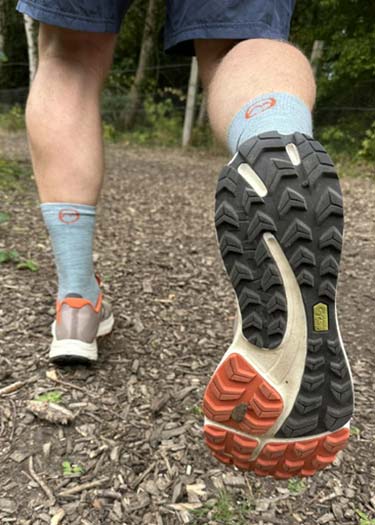 The Inov-8 Trailfly range is built for hard-packed trails — that mix of road and trail you get on a lot of routes. The Pro sits at the top of the range as the lightweight, racy option, and it’s really at its best over shorter ultra distances.
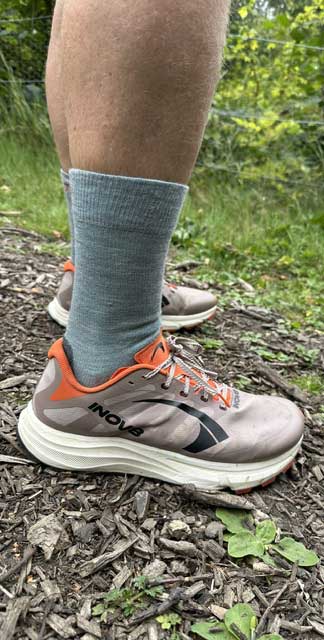
The first thing that hits you is how light it is. A UK 8 comes in at 228 grams, and on your foot it feels even lighter than that number suggests, because the shoe just moves with you. There’s no rigid frame telling your foot what to do — it flexes and bends wherever it wants to. The heel cup has a light bit of padding, soft and pliable, and once you’ve got the laces done up it pulls in nicely around your heel. Because the shoe is so flexible, there’s no annoying gap or pull between your heel and the shoe — it just feels locked in. Same story through the midfoot: the laces cinch the upper down snugly so your foot isn’t sliding forward on the descents.
Up front, the toe box is broad and rounded. If you’re coming from a more traditional shoe and haven’t tried something with this anatomical shape before (think Altra, Topo, or VJ), it’s going to feel roomy — maybe even a bit too roomy at first. That space is deliberate though. It lets your toes spread out on landing, which stretches the plantar fascia (basically a big elastic band on the bottom of your foot) so it can absorb shock and then spring you back off the ground. Spreading the feet also helps with balance, so you end up more stable and nimble over rough, broken ground.
If you’ve spent years in narrower, stiffer shoes, that extra space is going to feel unfamiliar — partly because you’re just not used to having room in there, and partly because your feet have probably forgotten how to spread on impact in the first place. Good news: that ability does come back with time. My advice, if this is new territory for you, is to ease into it. Rotate the Trailfly Pro in with your current shoes rather than jumping straight to wearing them for everything, the same way you’d ease into hill reps or track intervals rather than throwing yourself in at the deep end. Give your feet, ankles and lower legs a chance to catch up.
The upside of a shoe that lets your foot actually do its job is that your whole body shares the load — feet, ankles, lower legs, knees, hips, lower back — instead of one joint getting hammered because a stiffer shoe was holding everything in place. Less inflammation, less overloading, more natural movement.
The upper itself is soft and pliable, and the padding around the heel and collar strikes a nice balance — enough for comfort without soaking up water on a wet run. The tongue is soft too, with padding running down the middle to stop the laces digging in, and extra padding up top so the knot doesn’t dig into your foot either. There’s a little tab the laces run through so the tongue stays put instead of sliding sideways, and an extra lace hole up top if you want to snug up the heel or try butterfly lacing.
Cushioning-wise, it starts with the Boomerang Lite footbed — a 4mm insole made from nitrogen-infused TPEE foam. That nitrogen infusion keeps air from escaping and stops water and grit getting in, and for something so thin, it gives back a surprising amount of energy without going flat or packing down mid-run.
 Under that sits Inov-8’s Powerflow Elite midsole foam — a supercritical TPEE with plenty of bounce, but it’s not one of those shoes that isolates you from the ground completely. It stays flexible, bending and moving with your foot rather than acting like a rigid platform. All told, stack height comes to 34mm at the heel and 28mm up front (4mm footbed, 4mm lugs, and a 26mm/20mm midsole). End result: a shoe that’s softly cushioned with a bit of spring in its step, but still feels planted and stable underfoot.
The 6mm drop makes it a decent match whether you’re a midfoot or heel striker, and that drop essentially disappears past the midfoot, which is what makes the front end so flexible. Under the heel and midfoot it feels lovely and cushioned on most terrain — the one exception for me was steep downhills, where I felt like I couldn’t quite get up off my heels and dance down the way I can in some other 6mm-drop trail shoes. That might just be me though — plenty of runners land heel-first on steep descents or simply have better technique than I do.
Going uphill, it’s a different story — I found myself running comfortably on my forefoot, with the effort I was putting in actually translating into forward (upward) motion. There’s a touch of energy return from the foam, but it never feels like the shoe’s doing the work for you. What I really noticed on steep climbs was how much pressure it took off my calves, purely because the shoe lets my feet spread and bend naturally. That makes the climb itself easier, and it also means you’ve got more left in the tank once you’re over the top and running on.
There’s a slight rocker built into the midsole — a bit of a curve that helps keep your feet turning over and encourages a quicker cadence and more upright posture. Loads of shoes do this these days, and it does take over some of the work your calves, hamstrings and glutes would otherwise be doing. It’s subtle here though — you notice the flexibility and natural feel of the shoe far more than you notice the rocker itself. The one place it stood out to me was on gentle downhill sections on good trails, where the shoe feels really smooth and plush underfoot.
Grip comes from 4mm lugs made with graphene-infused sticky rubber — good traction on wet and dry roads alike, and durable with it. Because the midsole is so flexible, the outsole can actually mould itself to the contours of the ground, putting more rubber in contact with the trail than you’d get from a stiffer shoe. That translates to better grip and a more stable feel underfoot.
Where a lot of heavily cushioned trail shoes start to struggle, the Trailfly Pro still holds up on rougher, more broken terrain — it’s flexible enough to handle it. Most shoes built for hard-packed trails are stiffer and pretty numb underfoot, which makes them a bit of a one-trick pony once the ground gets technical.
On sizing: Inov-8 runs similar in length to Hoka, New Balance, Karhu and La Sportiva. If you’re usually in Brooks, Saucony, 361, Topo or Altra, go up half a UK size for a comparable fit — a UK 11.5 in Inov-8 is roughly the same length as a UK 11 in Brooks.
In summary the Inov-8 Trailfly Pro is a lightweight well-cushioned trail running shoe designed for hard packed terrain. The anatomical shape to the toe box and flexible midsole gives the Trailfly Pro a very natural and grounded feel to the ride.
Alternatives to Inov-8 TrailFly Pro
La Sportiva Prodigio Pro: The difference between the Trailfly Pro and Prodigio Pro is the ride. The Prodigio Pro midsole has a bit more stiffness which makes it feel less natural and reduces foot function, but the shoes does carry you a long that bit more. Doing that bit more work for you. https://www.northernrunner.com/blog/la-sportiva-prodigio-pro-review/
Hoka Tecton X 3: A much narrower fit with a more restrictive toe box. Hoka shoes are designed to replace your feet not work with them which is a different approach to Inov-8 who makes shoe to enhance the body’s natural function. The ride of the Tecton X 3 feels very different for the reason and even though it is flexible you do feel like you are riding the shoe with very little feel for the ground. https://www.northernrunner.com/blog/hoka-tecton-x-3-review/
VJ Ultra 3: A similar anatomical shaped toe box but doesn’t have quite the same width and volume. The Ultra 3 is much more cushioned with a more noticeable rocker. This takes away any feel for the ground. What replaces it is a very soft bouncy midsole. The stiffness makes the Ultra 3 less versatile as it doesn’t mould to the ground well so doesn’t cope well with broken terrain. https://www.northernrunner.com/blog/vj-ultra-3-review/
Altra Mont Blanc Carbon: A broad rounded toe box stimulates foot function. The carbon plate is very flexible and is designed to work with the foot to increase the spring rather than replace the foot. https://www.northernrunner.com/blog/altra-mont-blanc-carbon-review/
Comments are closed here.