
Hoka Clifton Pro Review
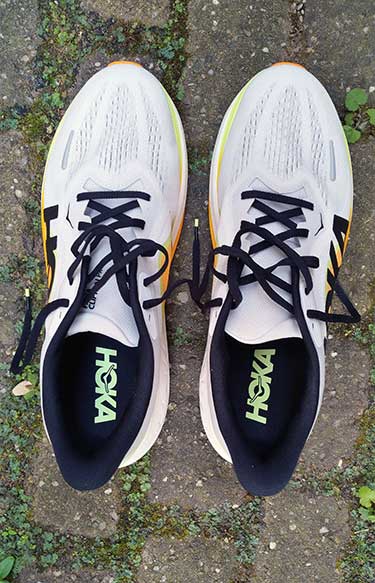 The Hoka Clifton Pro is an everyday road running shoe for the neutral runner. Suitable for everyday easy runs and long runs, it adds a bit more bounce and propulsion than the standard Hoka Clifton, which is now in its 11th version. Whether this is a better option for you than the Hoka Clifton 11 depends on how you like the ride of your running shoes to feel and what type of running you intend to do in them. The Hoka Clifton 11 has a softer, more forgiving ride to help tired and achy legs recover from the previous day’s long run or track session. The Hoka Clifton Pro has a firmer feel to the cushioning, with more noticeable bounce and energy return.
The rocker, or curve, of the midsole is a little more aggressive, so it propels you forward slightly more effectively and helps you raise the pace beyond an easy recovery run. It is ideal if you like a more versatile easy running shoe that also feels good at quicker paces, allowing you to put pick-ups into your long runs without feeling as though you are dragging an overly soft, cushioned running shoe along. It is also a good option for runners who simply do not like the midsole foam in their running shoes to feel too soft.
The fit is similar to the new Hoka Clifton 11. It is a bit roomier in the toe box than the average Hoka running shoe, which tends to be on the narrow side. This does not make the toe box roomy enough to allow the feet to spread fully on impact, but there is enough room for your toes to wiggle if you have average-width and average-volume feet.
The big-toe line is straight, which allows for a positive push-off. This helps amplify the feeling of propulsion you get from the rocker and the bouncy foam.
The stack height is the same as the Hoka Clifton 11: 38mm in the heel and 30mm in the forefoot in the women’s shoes, and 42mm in the heel and 34mm in the forefoot in the men’s shoes. However, you are much more aware of the 8mm heel-to-forefoot drop and the overall stack height because the midsole does not compress when you stand up in the shoes in the same way as the softer midsole of the Clifton 11. As a result, the Hoka Clifton Pro does feel like a max-cushioned running shoe.
As you would expect from a running shoe designed to be used daily, the Hoka Clifton Pro has a nicely padded heel cup and cuff. The Achilles tab is bent away from the Achilles to minimise any potential rubbing. The tongue is equally well padded and is attached to the base of the shoe by a piece of mesh on either side. It is a bit like a gusset in a trail running shoe, but it is only used to attach the tongue to the base. This gives the upper a snugger fit around the midfoot and helps prevent the tongue from slipping to one side when running. The upper is made from a soft and pliable engineered mesh. When the laces are tied, the upper is pulled in around the foot to give a snug fit at the heel and through the midfoot. There is an open, breathable mesh over the toes, and the forefoot is roomier than you would expect in a Hoka road running shoe. There is also an additional lace hole at the top of the laces. This can be used to make the heel fit more snugly or to butterfly-lace the shoes.
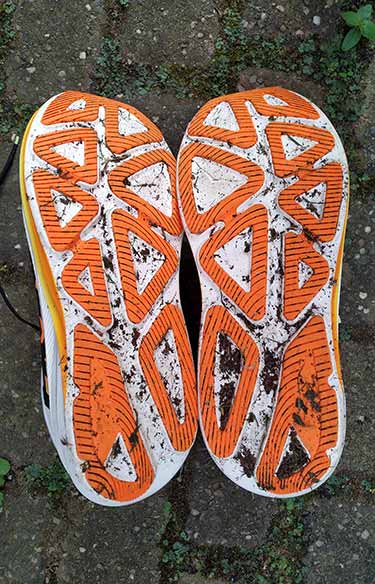 The midsole foam is called ProGlide+ and is a supercritical EVA. This differs from the compressed EVA used in the Hoka Clifton 11 because it is sealed. This means the air cannot escape, which gives the foam a degree of bounce. It also means that water and dirt cannot get in, which should make the midsole more durable. Unlike the compressed EVA midsole used in the Hoka Clifton 11, the ProGlide+ midsole should not compress as quickly. The 8mm heel-to-forefoot drop should therefore remain more consistent throughout the running life of the shoes, whereas you would expect the midsole of the Clifton 11 to compress gradually over time. This affects the lifespan of the midsole but, more importantly, the ride or feel of the shoes. A compressed EVA midsole will deform and compress, flexing where your feet do. The ProGlide+ midsole will not do this as readily, so the ride you have initially should remain more consistent throughout the lifespan of the shoes.
Which midsole is best depends entirely on how you like your running shoes to feel. The Clifton Pro carries your foot through the gait cycle more effectively. This can feel controlling to some runners and very comfortable to others.
As mentioned in the Hoka Clifton 11 review, I found the Clifton 11 softer than the previous version, offering a very comfortable, cushioned ride. The Hoka Clifton Pro feels much smoother because the stiffer midsole carries you through the gait cycle more effectively. This makes it easy to let the pace of your easy runs drift upwards, as the shoes carry you along. Whether this is a good thing depends on what you want from your running shoes.
The firmer midsole and more effective rocker made the Hoka Clifton Pro a nice shoe to use for long runs with pick-ups. There are bags of cushioning, so your legs are protected when you are running slowly, but when you pick the pace up slightly, the shoe comes with you and it is easy to cruise along at a quicker pace. The Clifton Pro also works well for long tempo runs, but for anything quicker than this, such as intervals or hill repetitions, you become more aware of the high stack height and stiff midsole. The outsole has a podular design, similar to others used on Hoka road running shoes. The rubber is grippy, even on wet tarmac, and has proved durable in our experience.
Hokas are a similar length to New Balance, Inov-8, Karhu and La Sportiva. If you wear Brooks, Saucony, 361, Topo or Altra, I would suggest trying half a UK size smaller to get a similar length. For example, a UK 11.5 in Hoka is a similar length to a UK 11 in Brooks.
In summary, if you are looking for a well-cushioned everyday running shoe that is versatile enough to feel good at slow paces and during some steadier running, the Hoka Clifton Pro is worth considering.
Alternatives to Hoka Clifton Pro
Mount to Coast C1: A much broader, more rounded toe box gives the feet more room to spread and function inside the shoes. The two layer midsole has a softer initial feel than the Clifton Pro but, the firmer base foam gives the C1 a similar level of propulsion. https://www.northernrunner.com/blog/mount-to-coast-c1-review/
Topo Atmos 2: A broad rounded toe box gives the feet the room to spread and function inside the shoes. The midsole has a similar level of bounce, but the rocker isn’t as noticeable, and the midsole is more flexible. https://www.northernrunner.com/blog/topo-atmos-2-review/
Saucony Ride 19: A narrower fitting toe box. Feels more like you are running rather than relying on the shoe to do the job for you. https://www.northernrunner.com/blog/saucony-ride-19-review/
Altra FWD Via 2: A broad rounded toe box allows the feet the room to spread and function inside the shoes. The midsole is similarly responsive but, less bounce which gives a more natural feel. There is a 4mm heel to forefoot drop and a slight rocker but, you still need to run in these shoes rather than ride the rocker which is the feeling you get running in a Hoka running shoe. https://www.northernrunner.com/blog/altra-fwd-via-2-review/
Inov-8 RoadFly Max: A broad rounded toe box allows the feet the room to spread. These have a very natural feel with no rocker. The midsole is firm and responsive. Available in two widths men’s and women’s. https://www.northernrunner.com/blog/inov-8-roadfly-max-review/
New Balance 880v15: A similar high stack with a firm responsive feel. Although there is a bit less bounce. Available in three width men’s and two width women’s. https://www.northernrunner.com/blog/new-balance-fresh-foam-x-880v15-review/
Brooks Ghost Max 4: A similar shoe but with a 6mm heel to forefoot drop. The midsole is less dense with more compression in the bounce. Available in two width men’s and women’s. https://www.northernrunner.com/blog/brooks-ghost-max-4/
Comments are closed here.