
Brooks Hyperion Elite v4 Review
After putting in plenty of miles, we’re ready to review the Brooks Hyperion Elite v4. The Hyperion Elite v4 is part of Brook’s ‘speed’ range of shoes. The Hyperion Elite v4 is a neutral, carbon plated racing shoe designed to be used for racing distances of 5km to marathon.
 Not an Everyday Jogger
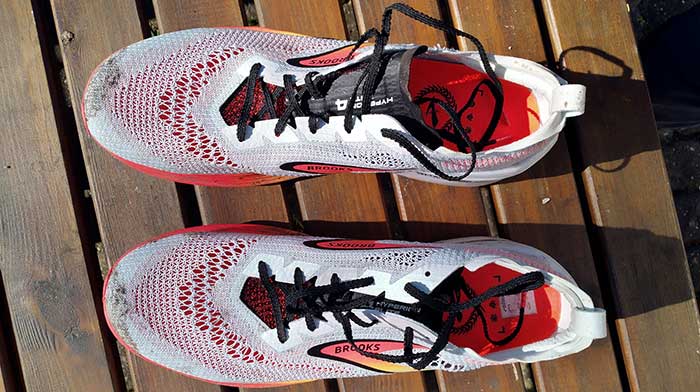
You can tell by the design that the Hyperion Elite v4 is designed purely as a race shoe. I hesitate to say that the upper is built for speed and not for comfort as the Hyperion Elite is still a very comfortable shoe. What it lacks is the padding and structure that you get in an everyday training shoe. The upper is woven and has a very open mesh. Similar to the open mesh used for the Altra Escalante Racer. This is a highly breathable upper. The air just flows straight through it. Lovely and cool on a hot day freezing cold on a frosty winter’s day. If you are going to road race in them in the winter, you will need some warm socks. The heel cup is floppy with a few padded bars that run under the ankle. The tongue has the most minimal amount of padding. The laces are slightly bobbled, to reduce the chance of them coming undone during a race and run through overlays to prevent them from pulling through the upper. The tongue is stitched to the upper on the medial side which together with the laces threading through a tab on the tongue prevents the tongue from slipping.
Upper, Heel & Toe Box
The upper pulls in nicely around my narrow feet but also fits my wife’s broad feet. The open mesh upper moulds well to different foot shapes while still holding the foot onto the midsole. The heel fit feels a little looser than it would be if it had a hard plastic cup within the heel cup. This is a similar construction to the Hoka Rocket X 2 which also has a floppier heel and like with the Hoka Rocket X 1 experienced no issues with slipping. If you did want to make the heel cup fit feel snugger than there is an extra lace hole. You can thread the laces through this hole or butterfly lace the shoes to pull the heel cup in snugger around your heel. Although the toe box isn’t rounded it does have a straight bit toe line. This allows you to toe off more strongly as the big toe is free to function. This is the same shape as Brooks use for the Hyperion, Hyperion GTS, Hyperion Max and the Ghost Max which is a move away from the more pointed toe boxes of the Brooks Ghost and Brooks Adrenaline GTS.
BROWSE BROOKS HYPERION ELITE 4
I used my normal size and they had the same amount of room as other Brooks styles. I find Brooks, Saucony, Topo Athletic, Altra, NNormal, VJ Sport and new brand Hylo the same. In Hoka, La Sportiva, Karhu and New Balance I go half a size up.
 Race Geometry
As well as being lighter than everyday running shoes, the modern day racing shoe also provides some propulsion. This propulsion comes from the rebound quality of the foam in the midsole, the curved shape of the midsole and the carbon fibre plate in the midsole. The foam used for the midsole of the Hyperion Elite v4 is DNA Flash v2 which is 10% lighter than the previous version and has 10% more rebound. The foam is 34mm thick at the heel and 26mm in the forefoot for an 8mm drop. The total stack at the heel including the outsole and insole is 40mm. Due to the steep curve of the midsole, which is often called the ‘rocker’, the heel to forefoot drop is less of an issue than it would be in shoes without a rocker. The rocker is designed to reduce breaking force when your foot touches the floor. Although your natural gait will dictate whether you land midfoot or further back on the shoe, the rocker is designed to keep your foot moving through the gait cycle. It helps you maintain a high cadence as you start to fatigue and also reduces over-striding. Brooks call the rocker ‘rapid roll’ which describes well exactly what the rocker does for you!
The Brooks Hyperion Elite v4 weigh’s 221 grams in a UK8. They are a light well cushioned running shoe designed for speed.
Carbon ‘Speedvault Race+’ Plate
Inside the midsole is Brooks SpeedVault Race+ plate. This is made using ‘additive moulding’, a new technology and uses bio-based materials. The production process produces nearly zero waste. To reduce the weight and increase the spring you get from the plate it has holes in it. Each plate is customised to each shoe size. That provides the optimal level of stiffness and spring at the correct point of the gait cycle. This is different to other carbon plated shoes that simply have a carbon plate that was designed to function in a men’s sample size e.g. US9 which is stretched or shrunk.
How it Feels
I have run in several different carbon fibre plated shoes, and they all feel a bit different. Quite often they feel very softly cushioned and almost carry you along. You often don’t feel in control of the pace and in effect you ‘ride’ the shoes. I also found that the really softly cushioned shoes bottomed out when running downhill and you sank into the midsole when running uphill. It often meant that on undulating routes I ran no faster and sometimes slower than I did in non-plated shoes.
 To me the Brooks Hyperion Elite v4 feels a lot more like a genuine running shoe. It works with my gait rather than takes over. When walking around, the midsole does feel soft, particularly on the heel. However, when running in the shoes they feel a lot more responsive. I have used them for intervals and fartleks but mainly for my steady/tempo runs, which is essentially running quickly for an hour. As carbon plated shoes do a lot of the work that your feet would be doing it is advisable to use them sparingly to avoid developing a weakness in your feet or calves. For that reason, I only use this type of shoe once a week.
Broke a PB
The route I often use takes me downhill for a number of miles before I turn around and try and get home in the same time it took me to run out. Previously this hadn’t been possible. I use a variety of shoes for this session. Some tempo type shoes that have a rocker and fast rebound foam, yet no carbon plate and other times everyday training shoes. The time the route takes varies with the shoes. Under an hour in a regular training shoe is good going for me at the moment! A tempo shoe will lower this time to 57 minutes. Other carbon shoes I have used have got me round in 56 minutes. I am down to 54 minutes in the Brooks Hyperion Elite v4. Everyone’s gait is different and for that reason these shoes might not be the perfect shoe for you but what is interesting is how they promote good form. They don’t just spring you down the road.
I didn’t run 54 minutes the first time I ran this route in the Hyperion Elite v4. I started with 56 minutes and the more I ran in the shoes the more I have learnt. Essentially the more force you push through the midsole the more spring or energy return you get. Other carbon plated shoes I have used work in a similar way but the Hyperion Elite v4 encourages you to lift your heels up rather than let the shoe glide your feet back. You have a lot more feel for the road, so you are more aware of what your legs are doing. This action reduces over-striding and keeps your hips high and your torso nice and upright. If you differ from this you can feel the roll isn’t as effective, and correct your posture. The only other running shoes that I feel this urge to lift my heels up in is Karhu running shoes. Karhu use a Fulcrum rather than a rocker, which gives a similar feeling.
The Hyperion Elite v4 develops a posture that allows me to ‘fall forward’. On the uphill it has stopped me from leaning over at the waist. I’m also looking up the hill, rather than at the ground. The difference in posture uphill is considerable and gave the greatest improvement on this section of my run. I have noticed that I work my lower abs and lower back more in these shoes, but on the whole I feel more recovered the following day than I do in other shoes. This might be the improved posture, the cushioning or a combination of the two.
Summary
I have done over 100 miles in the Brooks Hyperion Elite v4 over an 8 week period. I feel that I now run faster in these shoes than I originally did and get more spring/energy return from them. The Brooks Hyperion Elite v4 is a race day shoe that can be used sparingly (perhaps once a week) for some of your faster training sessions. I think that you learn to run faster in the shoes over time.
Other Considerations
Although there is nothing wrong with rotating shoes from different brands it can help get used to the rocker/ride of one brand. If you’re a Brooks fan and decide to use the Hyperion Elite v4 as your racing shoe then you could use the Brooks Hyperion Max for your steady runs, Hyperion for your really short quick efforts and Ghost Max (if you want rocker) or Ghost (if you don’t want a rocker). A rotation similar to this allows you to stimulate your body differently on different runs which reduces injury and helps improve the effectiveness of your training.
Hoka Rocket X 2: The foam in the midsole is a lot bouncier which does take away the feel for the ground and your running action. The rocker guides your foot back and has a feeling that you are riding the shoes rather than running in them. This makes you feel like you are doing less work. https://www.northernrunner.com/blog/hoka-rocket-x-2-review/
Hoka Carbon X: A shoe designed for the marathon and beyond. These shoes do a lot of work for your feet and carry you a long a bit faster for the same level of effort. https://www.northernrunner.com/blog/hoka-carbon-x-review-carbon-fibre-running-shoes/
New Balance FuelCell SuperComp Elite v4: The latest version of New Balance’s popular carbon fibre plate racing shoe. https://www.northernrunner.com/search/elite-v4
Hoka Cielo x1: The latest carbon plated racing shoes from Hoka. Much softer with a much more noticeable rocker. We have a review out shortly: HOKA Cielo X1
Comments are closed here.