
Altra Paradigm 7 Review
The Altra Paradigm 7 is a maximum cushioned road running shoe designed to offer some anti-pronation assistance, should you require it. As a result, the Altra Paradigm 7 can be used by neutral runners who like a stable ride as well as mild pronators. A few of us have ran in the Paradigm 7, so here’s our review.
Zero Drop
Like all Altra running shoes (a low drop shoe is actually coming soon), the Paradigm 7 is Zero Drop. Some customers found that confusing at first. It doesn’t mean it’s not cushioned, hard or anything of that nature. Instead, the height of the midsole at the heel is the same distance above the ground as the height of the midsole in the forefoot. Imagine the extreme alternative, a ladies high heeled shoe, where the heel is way higher that the toe.
 Toe Box & Last Shape
Altra make their shoes in three different lasts that offer a different amount of volume in the shoes. The Original, Standard and Slim, which are higher volume & broadness to lower respectively. A broader, rounded toe box shape gives your feet the room to spread on impact and function inside the shoes. This means that your feet sit in a natural position and your weight is evenly distributed. This promotes a more natural gait, allowing the runner to land on their midfoot, loading the foot naturally. This is so all the 26 bones, 33 joints and hundreds of muscles and ligaments can function correctly to cushion and stabilise you before springing you into your next stride.
Which last shape is best depending on the volume of your feet and the type of running you are doing. The Paradigm 7 is made on Altra’s Standard last. It is also available in a wide fit option for those runners that need a little bit more volume. The wide fit isn’t actually any broader at the base. It has more volume in the upper. In order for a low or zero drop shoe to improve your foot strength, reduce injury and help you run quicker you do need to make sure that there is enough volume in the shoes to give your feet space to function. If your feet are bulging over the sides of the forefoot, then there isn’t enough room for your feet to spread within the shoes.
Midsole & Stack
The Altra Paradigm 7 has the same high 30mm stack height of the previous version, consisting of the same Ego Max foam. The feeling of the midsole is plush and cushioned but not overly soft or soggy, lacking in energy return. You don’t feel like you are sinking into the midsole. This is deliberate, as if the midsole is too soft your foot doesn’t ‘know’ it has touched the floor and won’t function inside the shoes. The Ego Max midsole has a bit of bounce. It’s coupled with the INNERFLEX, which are tiny slits cut into the midsole to help the shoe flex where your foot flexes, rather than Altra guessing and placing pre-determined grooves that might be too far forward or back for your foot. This helps promote a natural midfoot strike, with your foot striking the ground under your centre of gravity.
Heel and Midfoot Landings
If you are used to walking and running in shoes with a raised heel your gait is likely to have been adjusted to land heel first. Your muscles ‘remember’ movement patterns, so despite the Altra Paradigm 7 allowing you to run in a more natural way, you may still land heel first. The thick responsive midsole of the Paradigm will allow you to land on your heel without any impact related issues. Over time most people find that by running in lower drop shoe their heel strike changes to a more midfoot strike, which spreads impact better. If you land heel first, all the force goes to your knees and hips rather than spreading from the feet up. This not only means that your body has to deal with more force, as your feet aren’t able to absorb any shock, but also that you lose the propulsion that you get from your feet. When you load your feet, they spread out, stretching the planta fascia on the bottom of your foot (a big elastic band) and recoils to spring you forward.
If you aren’t used to low drop shoes, build up time (and strength) in them gradually.
Heel
The Paradigm 7 has no plastic in the heel cup of the shoe. However, the heel cup is still stiff enough to supply some support due to some firm overlays on the outside. The lack of plastic in the heel cup means that the heel of the shoe is pliable and will hug the shape of your heel better. This reduces the chance of any slippage or blistering. The cuff and heel cup are lightly padded, which provides a comfortable fit whilst allowing the upper to pull into the shape of your foot. An internal strap pulls the upper in around the midfoot.
 Upper & Lacing
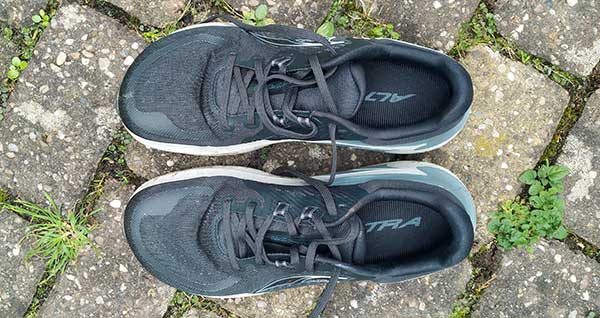
On the Paradigm 7 there is an extra piece of overlay over the upper that sits above the big toe. This is to help prevent the runner from pushing a hole through the top of the shoe. If you have enough room in your shoes, then this shouldn’t be an issue anyway. You should have a thumb width between the end of your longest toe and the end of the shoes when standing and laced up. Width wise there should be no bulging at the sides of the shoes. Some runners’ toes still lift up. This might be because they have worn shoes that have a pointed toe box and have been narrow fitting, squashing them upwards with nowhere to go. Muscles and ligaments have memory, but over time they’ll spread more naturally.
There is an extra eyelet at the top of the laces so you can butterfly the laces should you need to in order to get a snug fit around the heel.
Overpronation
The Altra Paradigm 7 is a running shoe designed to help reduce over-pronation. When your foot lands on the floor your arch compresses to absorb the shock. It should then reshape, and you should push off from under your big toe. Over-pronation is where your arch doesn’t re-shape quick enough, and you push off from the inside of your big toe or foot. As running is repetitive, this action is repeated several thousand times in a single run. This can lead to blisters on the inside of the foot, pain in the ankle, under the kneecap, outside of the thigh or lower back. As the foot rolls inwards, the leg follows and the joints of the ankle, knee and hip are slightly out of alignment as you push off. Other symptoms can include pain down the front of the shin, below the kneecap, outside thigh or in the lower back.
Historically, overpronation in runners has been controlled by stopping or reducing foot function. Elevated arches were put in shoes to reduce how much the arches compressed. The inside of the midsole was hardened up to encourage the foot to stay on the outside of the shoe to prevent rolling inwards. These mechanisms worked initially but over time the feet got weaker and you ended up needing gradually more and more support in your shoes, which made it harder and harder to run.
How to reduce the issues caused by pronation is now viewed differently. Instead of stopping the movement, the thinking is that you need to allow the foot to function and move it quickly through the gait cycle. Altra has the Paradigm 7 and Provision 7 designed to help overpronators. They both use a GuideRail to guide the foot to toe-off from under the big toe.
Pronation is naturally reduced in Altra shoes because they are zero drop. If you have an elevated heel on your running shoe, this facilitates heel striking and at heel strike your body is stopped from moving quite abruptly. If your feet tend to roll inwards, this sudden braking will make you roll inwards a lot. It’s not magic though, it might take a little time to improve whilst your feet, toes and legs function better and get stronger.
Lots of Cushion
The Altra Paradigm was Altra’s first maximally cushion shoe. The high level of cushioning helped facilitate the move to zero drop for those with weaker feet because the cushioning dampened the impact, especially compared with ‘barefoot’ style shoes. Ever put a barefoot shoe on with no experience and done a few miles?!
We had a lot of customers buy the well cushioned Paradigm, as the broad rounded toe box and high cushion made them very comfortable, especially if you have issues like bunions. When customers came back to replace their shoes, they were excited to tell us they were no longer in pain. The big toe had started to straighten up, their feet had got broader, and they developed gaps between the toes. They were repairing the damage from narrow shoes.
In Summary the Altra Paradigm 7 is a well-cushioned everyday road running training shoe that is perfect for the everyday miles, easy recovery runs and long runs. It will support mild overpronation but feels great for neutral runners (like me during all my review miles). We even found that it was responsive enough for pickups during long runs or fartlek sessions. It’s not designed for the realty fast stuff and the Paradigm 7 would suit everyone, from newcomers to zero drop, or even those new to running looking to run with the best posture and form from day one.
Other Considerations
The Paradigm 7 is one of three highly cushioned road running shoes that Altra produce. The Altra Torin 7 is considered the neutral version of the Paradigm 7 with the same 30mm stack height, but neutral runners can use both. The Torin 7 has a softer ride and feels less stable (no GuideRail), which is fine for neutral runners without issue. Although both shoes are made on Altra’s Standard last, the Paradigm has more volume (height) in the upper and for that reason would fit a higher volume foot better. https://www.northernrunner.com/blog/altra-torin-7-review/.
The third highly cushioned road shoe from Altra is the Via Olympus, also neutral. This is made on Altra’s original last, has more volume in the upper, has a 33mm stack height and a firm ride. These are a stiffer shoe, with a rocker construction. They aren’t as ‘easy’ to run long slow jobs in as the Paradigm or the Torin in our experience and are best for long runs where you are cruising along quicker. In effect a road version of the Olympus 5.
https://www.northernrunner.com/blog/altra-via-olympus-review/
Overpronation Support Alternatives
Karhu Mestari: The fulcrum and rocker help you maintain a quick cadence and good posture which will help reduce pronation. The cushioning is similar in firm and bouncy. https://www.northernrunner.com/blog/karhu-mestari-run-1-0-review/
Brooks Adrenaline GTS 23: Available in two width Women’s and three width Men’s but, the toe box is much pointier. Although the GTS 23 does have a straighter big toe line than the previous model. The Adrenaline GTS used guiderails. So, similar to the Paradigm it too can be used by neutral runners who like a stable ride as well as over-pronators. https://www.northernrunner.com/blog/brooks-adrenaline-gts-23-review/
Topo Ultrafly 4: A similar broad rounded toe box with 5mm heel to forefoot drop. Topo also believes in a allow your feet to function inside the shoes similar to Altra. The ride is similarly firm but, less stack height makes it feel less cushiony. https://www.northernrunner.com/blog/topo-athletic-ultrafly-4-review/
New Balance 860: Available in three width Men’s and Women’s. Softly cushioned. The toe box is quite pointed. https://www.northernrunner.com/blog/new-balance-860v12-review/
High Cushioned & Neutral
On Cloudsurfer: A broad toe box. Not quite as rounded as Altra or Topo but, plenty of space and the big toe line is straight. The cushioning is very, very soft which makes these a focused on easy running. https://www.northernrunner.com/blog/on-cloudsurfer-review/
Hoka Bondi 8: The original max cushioned, neutral road running shoe. Available in two width Men’s and Women’s. A narrower fit then Altra. The shoes have a very pronounced rocker to help increase cadence and maintain good posture. It feels like the shoes control your gait more in comparison to the more natural feel of an Altra shoe. https://www.northernrunner.com/blog/hoka-bondi-8-review/
Comments are closed here.