
Altra Lone Peak 5 vs Lone Peak 6 | Lone Peak 6 Review Part 1
In this article we’ll describe in our opinion, the difference between the Lone Peak 6 and the Lone Peak 5.
Origin
The Lone Peak was Altra’s original trail shoe and came onto the running shoe market over 10 years ago. Developed by Golden Harper and Brian Beckstead, the story goes that Brian was trying to finish a 100-mile event and was suffering with various injuries, pain and blisters. The higher milage was defeating his feet! The pair discovered that a lot of the problems were caused by running shoes with higher heels and pointed toe boxes not allowing for foot function and altering the natural gait of the runner. Brian Beckstead went from dropping out of the Wasatch 100 at mile 60 with his feet held together with duck tape to finishing blister free the following year in their Lone Peak prototype. The Lone Peak has continued to develop over the last 10 years, with Lone Peak 6 being the latest version.
What is Lone Peak?
The Lone peak is Altra’s pure or “out and out” trail shoe, as we often describe them. Designed to be versatile enough for hard packed tracks but nimble and grippy enough for some softer terrain too. Not quite so much for plodding along the road for a couple of miles, like higher cushioned shoes. The Lone Peak 6 is still equipped with an Altra EGO midsole and MAXTRAC outsole. This gives a softer feel to the cushioning without taking away too much feel for the ground. You can be nimble and get enough feedback from the floor for your feet to function in the shoes and allow you to run with good posture.
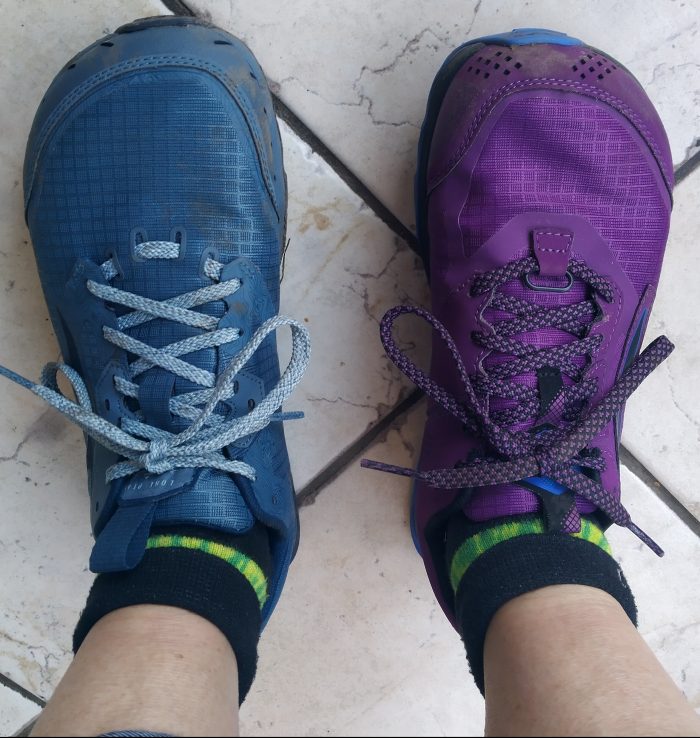
Lone Peak 5 (right) has “baggy” appearance as a result of more material in the upper.
The Volume & Fit
The Lone Peak 6 is fractionally lighter than the Lone Peak 5 but that isn’t particularly noticeable when running in the shoes. The real difference between the Lone Peak 5 and the Lone Peak 6 is the fit. The Lone Peak 6 has additional lace loops in the midfoot. This gives a more locked down fit. The main difference comes from the shape of the upper and the reduction in the material in the upper. Essentially the Lone Peak 6 feels and appears (pictured) less ‘baggy’. It still has a broad rounded toe box and is made on Altra original last so there is plenty of wiggle room for your toes. If you have a higher-volume foot then the Lone Peak 5 may still be a little better fit, but for a lot of runners the fit of the Lone Peak 6 will make the Lone Peak feel like a much nimbler shoe.
The Width
The Lone Peak 6 Wide, like the Lone Peak 5 Wide is actually no wider than the regular width, yet has more volume in the upper to fit a higher volume foot. Depending on the shape of your foot this would make the Lone Peak 6 Wide worth a try if you usually only fit in men’s 2E/4E or women’s D/2E running shoes.
The Heel to Forefoot Drop
All Altra shoes without exception are Zero Drop, which means that they are flat from heel to forefoot. This is to allow you to run in a more natural gait, landing on the midfoot. This loads the foot properly so that it can spread on impact to absorb the shock and then spring you into your next stride. This means that your feet, ankles and lower legs will work harder in an Altra shoe than in a stiffer shoe with a high raise and a pointed toe box. For this reason, it’s a good idea to gradually increase the time you spend in these shoes if you aren’t used to this type of shoe. This way your feet, ankles and lower legs with get stronger without getting overloaded.
Comments are closed here.