
Mount to Coast M1 Review
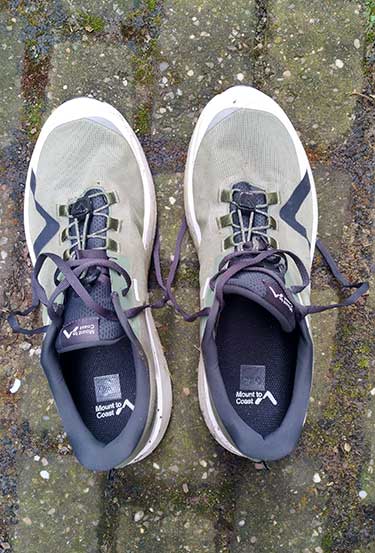 The Mount to Coast M1 is their most cushioned trail running shoe. Designed for long-distance trail runs and races, the M1 has a soft and bouncy feel to the ride. The focus is on cushioning and protection rather than being responsive with some feel for the ground.
A lot of trail running shoes designed for Ultras become plodding shoes. The shoes are stiffened up so they offer some support when you have been on your feet all day. They feel great at ‘Ultra pace’ but lack the versatility to feel good at anything quicker and promote more of an Ultra shuffle type of gait. At any quicker pace, they feel heavy and stiff. Mount to Coast has taken a different approach, producing a trail running shoe designed to be supportive enough and cushioned enough for 100-mile races and beyond, yet also be runnable enough for shorter outings.
Mount to Coast is a running shoe brand that has been developed to go the distance. The midsole foams are resilient, so they don’t lose their bounce or flatten out quickly, meaning that you will get a good number of miles out of them. Perhaps more importantly, it means that as long as your shoes aren’t significantly worn before you start, you won’t get partway through an Ultra and feel like all the rebound has gone from your shoes. The foam that Mount to Coast has developed is called JetCell. They have taken materials from the automotive industry and developed them to produce a foam that is light and bouncy but doesn’t get damaged easily by rocks or thorns on the trail and maintains its bounce for longer.
A men’s UK 8 weighs 275 grams, which feels light in your hands. When running, the bounce and general ‘runability’ of the shoes make them feel light on your feet too. The stack height is 38mm in the heel and 34mm in the forefoot. The midsole is pliable, so it does absorb small rocks and roots on the trails, and your foot sits inside the midsole. Both of these factors help to make the M1 feel less stacked than it is and more stable on your feet. The only time I was aware of the stack height was when running on a steep camber. In this instance, the midsole isn’t flexible enough to bend to the surface simply because of its thickness.
The 4mm heel-to-forefoot drop allows you to run with a more natural gait. There is no high heel that catches the floor, and your foot can relax in the shoes. The low drop promotes more of a midfoot landing, but if you are a heel striker, then the thick chunk of JetCell under the heel will cushion your landing without deforming or collapsing and carry your foot through to toe-off.
The heel cup is padded but not excessively, so the M1 won’t absorb a lot of water. The heel cup is quite stiff so that it holds the heel inside the midsole to give a stable ride. The tongue is very soft and pliable, allowing it to mould to the shape of your foot easily. The padding is soft and, although it is thin, has a luxurious feel to it. The tongue is attached to the base of the shoe with a mesh fabric on the medial and lateral sides. This mesh material is elastic and helps to give the M1 the feeling of a snug fit the moment you slip your foot into the shoes.
The laces have the Mount to Coast signature lacing system. This is where the top three holes have a conventional fabric lace and the bottom three tabs have a pull cord. This setup allows the runner to adjust the top or bottom section of the laces independently. So, if you feel that your foot has expanded and the shoes are getting a little snug at the toes, you can release the pull cord to give your feet more space without having to undo and then re-tie your laces.
The tongue has a tab which the laces thread through to prevent it from slipping to one side when running. There is also an elastic tab that can be used to slip any excess lace under to prevent it from getting untied by the undergrowth while running. There is an extra lace hole at the top of the laces which can be used to make the heel fit snugger or to butterfly lace the shoes. The laces are attached to tabs in the upper that are secured at the base of the shoes. So, when the laces are pulled tight, the upper is pulled in around the midfoot. This helps to reduce movement and slippage in the shoes when running on steep descents or rough terrain. The toe box is roomy, a bit boxy and more rounded than pointy. It is designed to allow the toes some wriggle room so that they can function inside the shoes and reduce the amount the foot will swell during long runs.
The overlay that forms the toe bumper is quite stiff and firm, offering a good level of toe protection. The whole feel of the Mount to Coast M1 is stability, protection and comfort. The ride of the shoes is very smooth and feels very easy. On my return from my first run of an hour or so, I felt that I could quite happily keep on going. The upper is made from TPEE blended yarns that are tough to reduce the chance of tears and abrasion. The upper is a fine mesh to allow water to pass freely through the shoe, which makes it breathable and also stops the shoe from gaining weight in wet conditions.
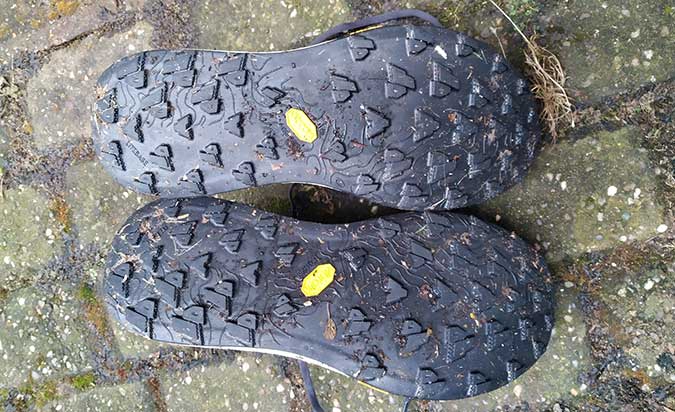 The outsole is made from Vibram Megagrip Litebase. This is a rubber that offers a good level of traction in both wet and dry conditions. It is also durable, so the 4mm lugs don’t wear down quickly. The lugs bite into soft trails reasonably well for their short length. As the thick midsole doesn’t flex a lot, it doesn’t shed the mud well, but this is a shoe designed for predominantly hard-packed trails, so a thick, cushioned midsole is more important than a flexible one that sheds the mud. Traction is good on hard-packed trails. Where it struggles is in situations where you require flexibility. For example, when crossing wet, moss-covered stepping stones. After numerous attempts at hopping from boulder to boulder, which led to me finishing my crossing on all fours, I decided that the best option was to splash through the stream. The M1 doesn’t hold too much water and dries well, and there is less chance of falling.
The M1 is a comfortable shoe on a variety of terrain. Hard-packed trails, some less broken singletracks and roads too. This makes them a good option for mixed routes. They are as cushioned as most road shoes, and the lugs ride quite smoothly on hard-packed surfaces. Vibram outsoles do make a bit of a noise, like running across the schoolyard in your football boots, but this is less noticeable in the M1 than it is in other shoes using the same outsole rubber.
Mount to Coast running shoes are similar in length to Brooks, Saucony, Topo, Altra, VJ and 361. If you use Hoka, New Balance, La Sportiva or Inov-8, then we would suggest trying half a UK size larger to get a similar length, e.g. a UK 11 in Mount to Coast is a similar length to a UK 11.5 in Hoka.
Some reviewers have mentioned that the Mount to Coast M1 fits a little shorter than other Mount to Coast running shoes. This isn’t our experience. What might explain this discrepancy is that the M1 has a much firmer toe bumper than other Mount to Coast models. This might mean that when your feet have expanded towards the end of a longer run, you are more aware of the harder toe bumper. When the shoes are laced up and I am standing, I have the same thumb width of space between the end of my longest toe and the end of the shoes as I do in all my other Mount to Coast running shoes.
I have found the M1 a very easy shoe to run in. I find that I can stumble out the door at 5.30am and instantly get into my stride. The cushioning has an element of bounce to it, which is more noticeable on hard-packed ground, but it isn’t excessive. It feels like it gives the shoes a bit of life.
The M1 isn’t a fast shoe. I find that easy morning runs take a little longer, as does my weekly long run. When picking up the pace to do pickups in long runs, I find that I am aware of the bulk of the shoe and the softness of the midsole. Something that at slower paces I am not aware of. However, this still makes the Mount to Coast M1 a far more versatile trail running shoe than other Ultra trail running shoes I have run in.
They don’t feel too soft or too stiff. They are comfortable from the moment you put your feet in them. I often find that morning runs the day after a track session, hills or intervals are a challenge. My legs are stiff and take a bit of time to warm up and get moving. In the M1, I find that I am into my stride straight away, and although some of the stiffness is still there, the shoes seem to reduce it a bit and I can enjoy my run.
In summary, the Mount to Coast M1 is an Ultra trail running shoe designed to keep you moving as the miles clock up. However, if Ultras aren’t your thing, don’t discount them, as they work equally well as a long run shoe offering that bit more protection or a more general easy run shoe. The M1 is a trail running shoe designed to go the distance and isn’t a speedster in any way.
Alternatives to Mount to Coast M1
Altra Olympus 7: A broader more rounded toe box gives the feet more room to spread and function in the shoes. The Olympus is much stiffer and feels bulkier on your feet than the M1. They feel best as Ultra pace but are very comfortable and supportive when you have had them on your feet all day which is why Altra making Olympus walking shoes, hiking boots and more casual versions. https://www.northernrunner.com/blog/altra-olympus-7-review/
Nnormal Cadi: A similar versatile trail running shoe. The Cadi is a bit more flexible but doesn’t have the same life or bounce in the midsole. A very comfortable shoe for plodding a long but you feel like the M1 carriers you a long because of the bounce that you get from the Jetcell foam on harder packed terrain.
https://www.northernrunner.com/blog/nnormal-cadi-review/
OMM Ultra Shoe: High stack heights and bouncy midsole foams lose the feel for the terrain. OMM have chosen to use an EVA based midsole to retain a nimbler feel to the OMM Ultra. Traction is better on soft ground too.
https://www.northernrunner.com/blog/omm-ultra-shoe-review/
Scott Kinabalu Ultra: A firmer more responsive feel to the ride and a curved or rocker shape to the midsole gives the Kinabalu more propulsion but reduces the plush cushioned feel that the M1 has. Traction is similar. https://www.northernrunner.com/blog/scott-kinabalu-ultra-review/
La Sportiva Prodigio Max: A roomy toe box gives the Prodigio Max a similar level of comfort. The midsole is firmer but still offers a high level of cushioning and protection. The midsole is stiffer but beds in to give a ride somewhere between the stiffness of the Altra Olympus 7 or Topo Vista and the Mount to Coast M1. Traction level is similar. https://www.northernrunner.com/blog/la-sportiva-prodigio-max-review/
Topo Vista: A broad rounded toe box gives the toes room to spread. The midsole is stiff which gives the Vista a good level of support. Ideal for longer outings however, not a versatile as the M2C M1 in that they feel good a Ultra pace and are hard to run quicker in. https://www.northernrunner.com/blog/topo-athletic-vista-review/
Hoka Mafate 5: Hoka invented the oversized midsole and rocker geometry in running shoes. The goal being to design a shoe that you could run an Ultra in every week by offering a high cushioning level and improving the running gait. The Mafate 5 is Hoka’s Ultra trail running shoe. The cushioning is soft but not too much. The rocker provides a bit of propulsion, and the forefoot plate give you a bit more of a push when you need it. The fit is more roomy than other Hoka shoes but still has a more pointed toe box than the M1. The rocker does take over the running gait a bit and you are much less aware of what you are standing on than you are in the M1. https://www.northernrunner.com/blog/hoka-mafate-5-review/
VJ Ultra 3: A more rounded toe box gives the toes room to spread. The supercritical foam is much softer than the foam used in the M1. I found them soft particularly on hard packed terrain. Traction is a similar level although the rubber does stick to wet surfaces a touch better. https://www.northernrunner.com/blog/vj-ultra-3-review/
La Sportiva Prodigio Pro: The Prodigio Pro adds in all the nice little touches. A sock like opening to keep debri out of the shoes. The midsole has a touch of bounce, but the midsole is thin enough to allow a bit of ground feel so you can tackle more broken ground easier. The rocker shaped midsole isn’t too aggressive but does add a bit of propulsion so you can pick the pace up a touch in the Prodigio Pro without feeling like it is a bit too bulky. Traction is a bit better mainly because the midsole can flex to the shape of the ground a little easier. https://www.northernrunner.com/blog/la-sportiva-prodigio-pro-review/
Comments are closed here.